Station 1 · note Mi
Giza Plateau (King’s Chamber)
The resonance generator of the Wheel; the launch of the chain
The point from which the work across the region begins.
When to go: dawn; night for the stars; midday is dangerous.
Find the place nearest to you on the map — and you’ll see what it is made of: 52 Gates of the Earth, three centres in each, 156 nodes in all. Each node has its own octave of eight stations, and it is already written out — this is the score of the place, not a list of sights. A node is not occupied and not booked: one and the same place is open to everyone at once.
You go to a node with the Mineral. This is a condition of participation, named from the very start: the journey is walked together with it — not as a souvenir, but as part of the route.
Nodes are the organs of the Earth’s crystalline body, and a journey through them is a great laboratory of consciousness. Every place has conditions that can be named and an observation protocol that can be repeated. Here you are both the instrument and the specimen: you don’t only feel, you also record. A quiet day without events goes into the log too — a negative result counts on a par with a vivid one.
On our map, this is Gate 5, the crown node, the Ether element — the summit of the same grid whose base is walked on Bali.
Eight notes, eight minutes, no registration. Complete it — and you will read this map just as the Wayfarer reads it on the ground.
Open on your phone → the “Living Planet” app: the nearest node and the distance to it are calculated right in your phone, without internet.
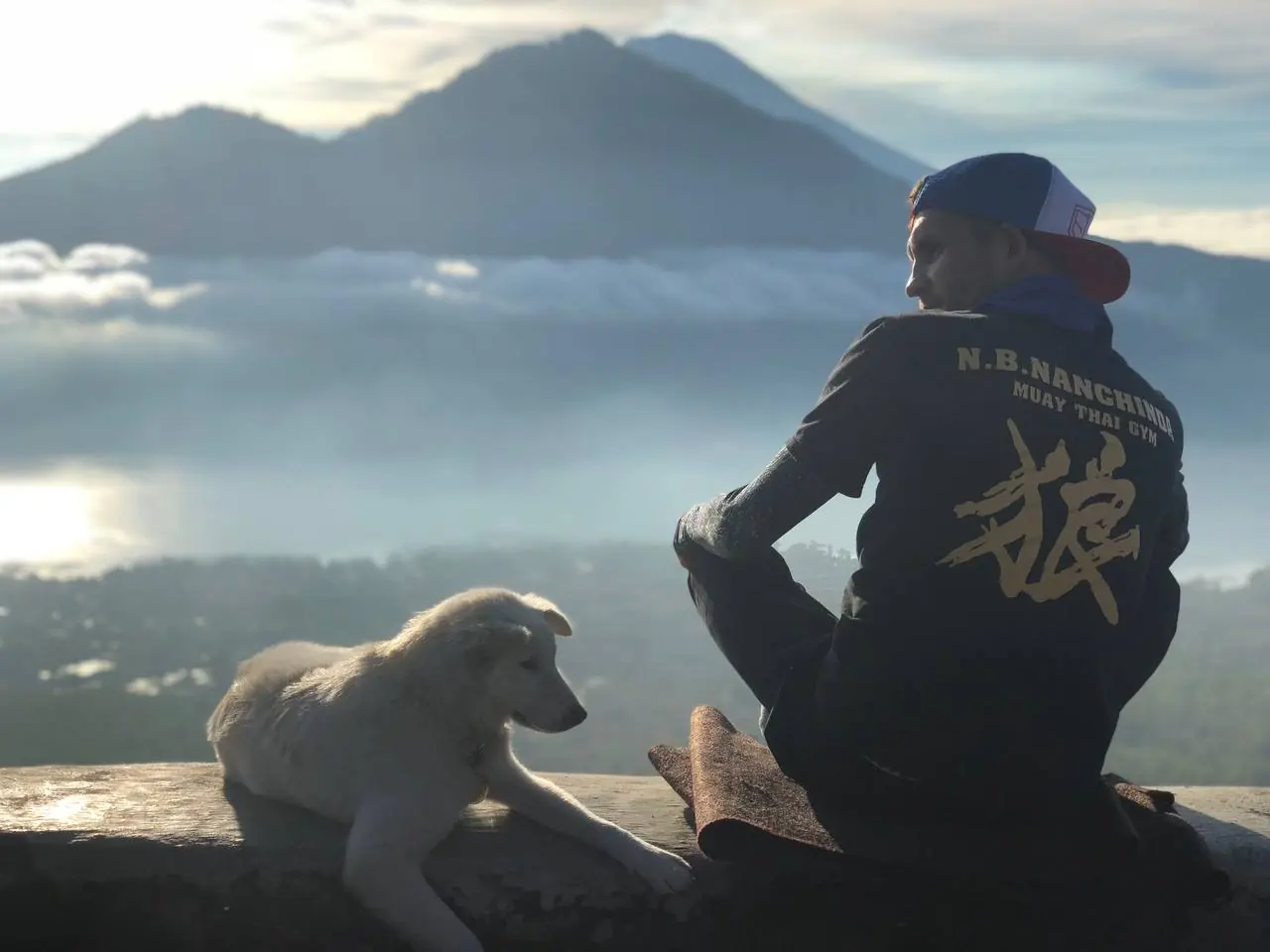
The journey stands on the second step: on the road you name in advance what you are going to learn about yourself, and you watch your own steps from the outside.
And at the end of the route the same road becomes a game: when seriousness lets go, what remains is the ability to act without strain — traditions call this Lila, and in this language the last node of the path can be shown.
On the platform as a whole, the main guide is the Mineral. In “Sacred Journeys” the protagonist is the Earth herself: a living liquid crystal with her own electromagnetic system. The Mineral is her son and a guide to her.
The 156 nodes of the grid are the map of this organism. At the nodal points the Mineral is not “found”: there it is prepared — the place sets the order, and the order is written into the crystal. author’s model · MUNS
That is why the section is built as an acquaintance with the Planet, not as a catalogue of sights. First — who she is. Only then — where to go.
The direction rests on one condition: a person goes not to look at a point, but to be a node in it. The Mineral goes with them and holds this connection — that is why it is required here, not merely desirable.
People at the points, the Mineral and the grid underfoot come together into a single scene where every participant is a living node. Hence the genre: not an excursion and not a lecture, but a role that you play.
In this scene the Mineral is a mandatory condition of participation, not a decoration of the role: the journey is walked together with it. It is what holds a person’s connection with a point of the grid — and the whole route rests on that.
Between the surface of the Earth and the ionosphere there is a resonating cavity. Lightning bolts — and the planet has dozens of them every second — keep striking this bell: a fundamental mode of about 7.83 Hz, then overtones. This is a measurable quantity, not a metaphor. confirmed
The planet has her own electromagnetic rhythm. A living system that comes into phase with its environment spends less — we pursue the link between the rhythms of the environment and a person’s state as an open line of research. research
The Earth holds a magnetic field around herself that deflects the solar wind. The field is not static: the magnetic poles drift, its strength changes, and the history of pole reversals is written in the rocks of the ocean floor. confirmed
We read this as the life-support system of a living body, not as a by-product of the rotation of the core. Hence the frame of the section: the planet has a rhythm, a field and a memory. author’s hypothesis
Rotating neutron stars send out pulses so stable that astronomers use them as clocks: pulsar timing arrays are used to search for the gravitational-wave background. confirmed source: NANOGrav, 15-year pulsar timing array, 2023
The beat is not set by us. The eight-note octave in this game — not a decoration, but a way of speaking about rhythm as the principle by which matter is organised. author’s hypothesis
In the theory of complex systems there is a state in which a system loses its former stability and becomes extremely sensitive to a small influence: what follows is the choice of a new branch. This is an ordinary field of science — synergetics and non-equilibrium thermodynamics. confirmed
“The Science of Transition” is the author’s reading: the planet and humanity are passing through such a point, and a small precise action weighs more in it than a large action in a stable state. Hence the meaning of the nodes: where sensitivity is higher, action is heard more clearly. author’s hypothesis
The Icosahedral-Dodecahedral System of the Earth by Goncharov — Makarov — Morozov: a framework of 62 vertices and edges. The authors note coincidences of the nodes with geophysical anomalies, migration routes and the hearths of ancient civilisations, work on the distribution of cyclones and a modulus of inter-hearth distances of ≈ 3500 km (Giza ↔ Mohenjo-daro). This is a frontier and a hypothesis of Soviet authors, not mainstream geophysics — and that is how we present it. research
The geometry of the Platonic solids themselves is strict, though: 12 vertices of the icosahedron + 20 vertices of the dodecahedron + 30 edge midpoints = the disdyakis triacontahedron (62 vertices, 180 edges, 120 faces). The coordinates of the framework are calculated precisely, not drawn by hand. confirmed
A megalithic complex in Armenia with sighting-stones: through-holes along which observations were made (the work of Herouni and Parsamian). Archaeoastronomy is a testable discipline, and this is an honest bridge between stone and sky. confirmed
Navasard on 11 August and the line of Orion echo the Egyptian “days outside time” — a beautiful link that we hold as the author’s map. The magnetic anomalies of the site carry the same label: a model, not a measurement. author’s hypothesis
🟢 “proven by science” sounds here like the riddle solved and the engine of the planet. “Working hypothesis” — like the rules of the quest, the researcher’s map, an invitation to explore. The “fact / model” division stays exactly the same — only the language changes: honesty intact, no tedium. There is one rule: we invite you to explore — and we leave every step open to checking.
Mount Kailash in Tibet is a sacred peak for four traditions at once and the point around which people have walked the kora for centuries. In the network of nodes this is Gate 5, the crown node, the Ether element — the summit of the same grid whose base is walked on Bali. author’s model
Beside the mountain lie two antipodal lakes: freshwater Manasarovar and salt Rakshastal, Chiu Gompa monastery on the shore, high-altitude Gauri Kund on the kora route and the village of Darchen, where the kora begins.
The line of nodes: Bali — the benchmark of the genre · Koh Phangan — the author’s laboratory · Kailash — recruiting the next group.
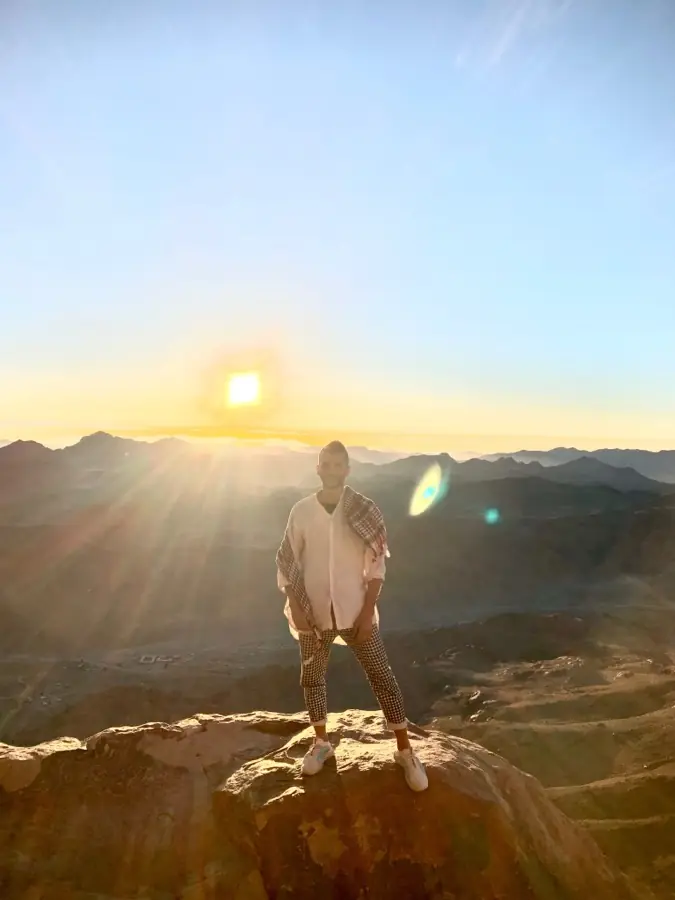
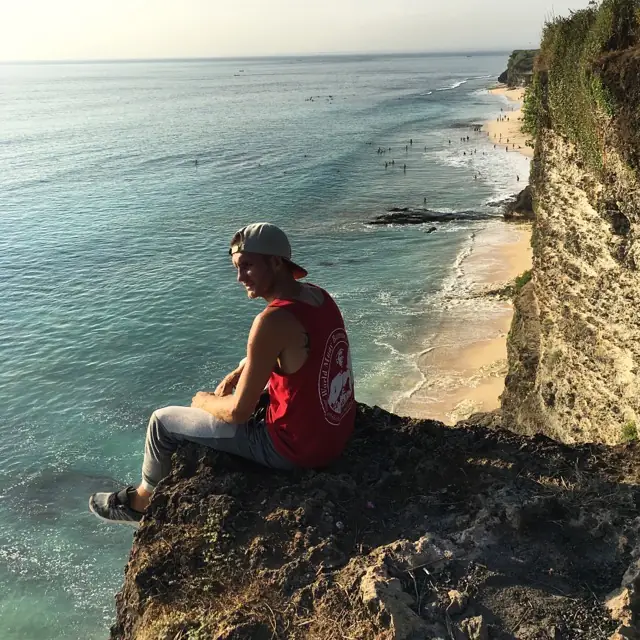
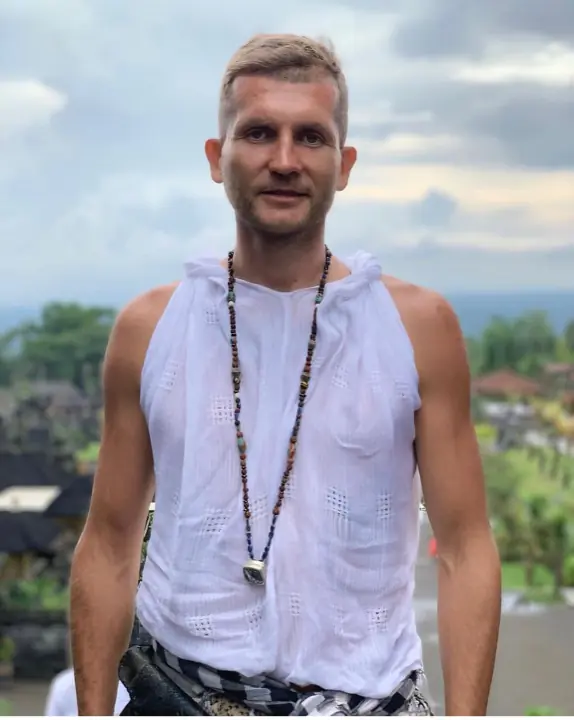
Three frames from the author’s road: ridge, cliff, temple. These are photographs, not drawings and not generated images.
The formula of the place in one line: the axis of the world that no one climbs. It is not conquered — it is walked around, and on the pass people are reborn.
The flagpole where the kora begins. Ahead — 52 km around a mountain that you will not conquer.
The Mirror of the Sources: a fresh solar lake and a salt lunar one side by side — polarity made visible in a single point.
The western valley, rocks and prayer flags: “The Wind of Flags”.
The northern face, a view of the peak and the “seam” staircase: the Fire of Reverence.
The climb over the moraines to the pass. The note is named plainly: “Leave the Old Behind”.
The highest point of the circuit and its culmination: “The Pass of Rebirth”. Not the summit of the mountain — that is inviolable.
The Lake of Compassion on the descent, and nearby — Milarepa’s cave.
The kora closes. You have walked around the whole mountain and have not climbed a single metre of its summit.
🔴 Climbing to the summit is taboo in all four religions — no one ever climbs Kailash. The quest is the kora only, with reverence. High altitude, 4600–5645 m: the altitude here is real and does not forgive haste; permits are mandatory, a guide is mandatory. Readiness is checked before the start, not on the spot.
On the island stands the Planetary Alchemy centre — the author’s laboratory: here he carries out his work; the centre does not receive guests. For the traveller, Koh Phangan is open as a route of eight places, and next to it in the network stands the Academy in Thailand.
The island route — “The island’s octave” →
The island’s passport is assembled to the same template as the one examined above: first the fabric of the place, then the octave. The order is the same for all nodes — no stamping out and no running ahead of the fabric.
Entry into the corridor of synchronicity
Why everything goes now your way, now against you →
On the road this mechanism is tested more honestly than anywhere else: the node is named in advance — what you are going to learn and by what sign you will know you have heard it. The sign must be capable of not coming true, otherwise it is not a path but a story told after the fact. “I named it beforehand — and here is what came of it” weighs more than “look how it matched”.
You are not holding a textbook. You are holding a treasure map.
Imagine that the Earth beneath your feet is not stone, but a living, breathing being. She has a pulse: the physicist Schumann calculated it, and instruments confirmed it — the planet hums at the note of ≈7.83 Hz, constantly, across the whole globe. This is her heartbeat, and this is a fact, not a fairy tale — that is the first riddle solved. fact
Half a century before Schumann, in the summer of 1899 in Colorado Springs, Nikola Tesla was recording the strikes of a departing thunderstorm and decided that he was hearing standing waves travelling across the whole planet: the Earth answers a strike as a whole. He wrote this down and added that he was now able to send a signal through the entire globe. No one could verify it at the time: the “Earth — ionosphere” cavity was calculated in 1952 and heard by instruments in 1960. fact This is the engine of our reality, and it is what we play with.
And now the ancient formula: “as above, so below”. What if a human being is a planet in miniature? The Earth’s rivers are like blood, the lines of force like nerves, and the special places on the map like her nerve nodes. Your centres mirror her centres. These are the rules of our quest: everything said here is tested on yourself. the rules of the quest
For thousands of years different traditions marked the same nodal points on the globe — and they converged: Shasta, Titicaca, Uluru, Glastonbury, Giza, Kailash, Bali… 156 nodes of one living grid. Each one is a level. Each one sounds its own note.
Your task is simple and immense: walk the nodes — in body or in thought — hear the note of each one and assemble yourself out of them. Science will explain how the engine works. The ancient map will show where to go. And the choice — to play with lightness and an open mind — is yours alone.
Welcome to the game where the stage is the whole planet.
The tourist looks — and does not see. He brings home photos of a place where he never really was.
The genre of this section is a 21st-century University: the lecture hall here is the landscape itself, the lecture is the passage between notes, and the exam is what you notice on the tenth day and did not notice on the first.
Feeds are overflowing with places people travelled to but never met. Shallow content has worn everyone out — and we make exactly the opposite move: we bring a person back to life through the ability to see.
This is not one more route around temples. It is the restoration of three skills a person had before they learned to scroll: noticing · asking questions · feeling Nature as a living organism — and serving her.
Learning here happens not at a desk but through living the experience on the ground: body, attention and question find themselves, for the first time in a long while, in one place and at one time.
The mission also works inward, within the platform: it brings in conscious people, from whom a team, a community and an international university are assembled. People come for meaning — and stay on as co-authors.
Attention is the researcher’s first tool. Not “photograph a sight”, but see what is happening here: how the stone lies, where the water goes, what the light does at five in the morning.
An answer closes, a question opens. Each point of the route gives you not a fact to memorise but a question to carry on with — into the diary and into the next note.
The planet is not a backdrop for a shot but a living organism with its own rhythms. Hearing them is the very passage from guest to participant: from “I came to look” to “I am here for something”.
“May everyone understand that life is one great process of play, where every obstacle serves us on the path to light and perfection”.
Vadim Kovalev · the final formula of the film’s manifesto
Play here is not a wrapper and not a marketing ploy. It is the author’s worldview, out of which grew both the platform’s quests and this very section: an obstacle does not hinder the path — it is the path’s own step.
Wherever we are, there is the node. The network does not end at ancient stones: the focus shifts from passively visiting ancient places to people and spaces themselves actively creating points of coherence. If you can’t fly to Bali, the node does not vanish because of that: it gathers where you are standing. author’s model
Planetary Alchemy University · seven fundamental sciences and the faculties →
Before walking the nodes, we honestly name where we speak from. The section has a scientific frame, two load-bearing pillars and a declared genre — and all three are named in advance, not attributed after the fact.
Science has not always looked at the world in the same way — it has passed through three ages, and we honestly name the one we stand in. Classical: Newton, Laplace, the Universe as a mechanism; the observer stands outside and influences nothing. Non-classical: Einstein showed that the picture depends on where you look from, and quantum physics added that the very act of observation changes what is observed — the observer stepped inside the picture. Post-non-classical: the name of this stage is linked with the philosopher of science Vyacheslav Stepin. fact of the history of ideas
🟢 The third age opened up a class of objects: complex self-developing systems, into which a person, their choice and their meaning enter as part of the system. The footing here is rigorous. Ilya Prigogine received the 1977 Nobel Prize in Chemistry for dissipative structures — order that arises by itself in systems far from equilibrium. Hermann Haken named the science of this synergetics. confirmed
The third age does not cancel the first two: Newton’s clocks still tick, quanta still flicker. It simply allows science to study what grows, breathes and organises itself. Hence the place of the observer — not as superstition, but as part of the system under study.
What the frame gives this section: it puts the whole conversation on one scale — from the measured to the explored, substituting nothing. Measurable physics — the Schumann resonance, geophysics, synergetics — remains 🟢 science; no one downgrades it. The map of nodes, grids and elements remains a hypothesis and an invitation to explore. But both live within one scientific horizon, not on opposite sides of the barricade.
And a boundary we never erase: the post-non-classical frame itself is a recognised philosophy of science, while applying it to sacred geography is our synthesis, not a consequence of other people’s work. The same goes for DSOT: the self-organisation of complex systems truly is the main object of this branch, but the word “directed” is our continuation and our hypothesis, not a conclusion drawn from the Nobel work. boundary of honesty
“We invent nothing of our own. All 156 points, their integration and their functioning are built on two unshakeable pillars”.
Vadim Kovalev · on the grid of 156 points
The author formulates the rule of intersection in the same place, in one line: “Any node on the map is the intersection of my author’s model and a proven (or hypothetically recognised) scientific basis”. Neither pillar works alone — a node holds where they converge.
This is “the core of meaning, the architecture of the Universe, the systemic lore and the author’s methodology for calibrating the environment”, and every node passport requires a direct reference to this model. author’s hypothesis
We do not dissolve it in other people’s theories: it is the Institute’s own model, a model-invitation, and every node passport stands on it.
Supports: the Icosahedral-Dodecahedral System of the Earth (the IDSZ of Goncharov–Morozov–Makarov), the Becker–Hagens vector model, research into the geomagnetic framework, archaeoastronomy (the work of Herouni and Parsamian) and quantum biophysics.
The list is an address, not a verdict of “proven”. Below, each item is named by its status: what is measured, what remains a hypothesis, and what is a different grid altogether. research
Not to be confused with the four pillars of Anamnesis below (A–D): those are about how a person lives through a node, these are about what underpins the claim made about it. Different axes; neither cancels the other.
The tone of the section is a science-fiction quest, a sacred journey, a living game instead of dry academism.
“…we are building a science-fiction quest as well… some part we place within esoteric science, some part we present as… our own author’s concept”… “…journeys, adventures, miracles — this is our motto”.
Vadim Kovalev · on the genre of the journeys
This is a declared genre, not a caveat added after the fact. The difference is fundamental: a caveat appears when someone has asked; the genre is announced at the entrance — before the first node, before the first map, before the first practice. The reader knows the rules of the game before starting to play.
The genre changes the language, not the status of a claim: the traffic light above is not softened one iota. What is measured stays measured, a hypothesis stays a hypothesis — it is just that physics sounds like the riddle solved and the engine of the planet, and the researcher’s map like the rules of the quest and an invitation to explore.
That is why the two registers live separately and do not mix. In the game layer the images work at full force — this is the genre, and it has been announced. In the scientific layer there is only strict discipline: the measured is presented as measured, a hypothesis as a hypothesis. The only thing forbidden here — passing off one register as the other.
The platform’s scientific circuit and the full knowledge traffic light →
Eight notes · how to read this map
Before going anywhere, it is worth learning to see. This chapter is itself built as an octave: eight notes — eight mechanics of the platform. Go through it here, on screen — and you will read any node on the ground with the same score.
The ability to read the network map: what a node is, the octave inside a point, the honesty traffic light, the Diary and the Twin.
Nothing. No registration, no e-mail, no “leave your contact to continue”. Your progress lives in your browser.
Your own pace and your own check: you look for yourself, count for yourself, move on when you are ready. There are no deadlines here.
Each note is one mechanic of the platform. Don’t be afraid to make a mistake: the breakdown comes either way.
The sacred body of the planet is a whole system. Water, temple and mountain points live in one space and with equal rights: there is no grand entrance here.
Your own node on this grid is assigned to you in your personal account — open “My node” →
Nothing you have walked is lost: the section “My path” in your personal account keeps the nodes you have stood on, the octave stations you have passed and your notes on them. The path is kept by the server — it is one and the same from any device and visible only to you.
Your browser does not draw the canvas — the map below works as a list, and that is a full entry point.
The framework carries the whole grid in full: 52 Gates × 3 points = 156 portals of the Earth, and all the points carry equal weight. The gold ring goes to the sixteen nodes whose passport has already been assembled to the full standard — this is the status of our work, not the rank of the place. The data are the same as those that feed the interactive Planet: there is one map, no second registry.
The whole Planet · filters and links →“There are 156 places in all — a person can choose any of them. These places are the junctions of the crystalline grid”.
Vadim Kovalev · on choosing a node
Hence the design of the map: the entry points are not assigned by us. There is no obligatory first location, no “correct” order and no paid pass to the one you need. The author adds the second half of the meaning to this: in these one hundred and fifty-six places a person can meet seekers just like themselves — and go through the class together, and the path itself can become a service to the planet. author’s model
Sixteen nodes whose passport has been assembled to the full standard and whose inner “Octave at the Point” has already been written. The order is by Gate number, not by importance: there is no first node in this list. The other points of the grid follow in order of readiness — an honest cadence, without stamping out. The card’s caption is a coordinate of the grid: the Gate plus the node’s element. The routes below have their own scale — the notes of the octave, and it has its own count, independent of the grid.
The order of the points here is not arbitrary. Each has a role within its own Gate, its own stretch of time and its own place on the geometric framework — three independent keys by which the map is read.
A Gate is not a point but a triad. Each Gate holds three places with different functions: Inspiring (Foundation) sets the impulse, Structural holds the form, Creative releases the new. Hence the arithmetic of the network: 52 × 3 = 156.
The distribution is even and can be checked against the registry: 52 inspiring · 52 structural · 52 creative. The role of each node is shown right on its card, next to the Gate and the element: it tells you why the network needs the point, not only where it lies.
The second axis is temporal. The nodes are laid out across four cycles, 39 in each: cycle 1 — 1989–2008, cycle 2 — 2008–2027, cycle 3 — 2027–2046 and the polar one — an Arctic-Antarctic tail running off into the Omega Sphere.
The sixteen nodes with an assembled passport lie in the first three cycles: cycle 1 — Glastonbury, Titicaca, Uluru, Bali, Kailash, Fuji, Giza, Elbrus; cycle 2 — Niagara, Arunachala, Kilimanjaro, Belukha, Olkhon; cycle 3 — Angkor, Denali, Klyuchevskaya. The cycle is labelled on every card — a route through the network can be built not only by geography but also by time.
Layer A · the IDSZ skeleton. The Icosahedral-Dodecahedral System of the Earth: 62 nodes, the disdyakis triacontahedron (62 vertices, 180 edges, 120 faces), also known as the Becker — Hagens UVG grid. The blue triangles of the icosahedron and the red pentagons of the dodecahedron — that very recognisable map. model
Layer B · the reference matrix. On top — a strict geodesic grid of the icosahedron at frequency v = 4: 162 mathematical nodes, 320 triangular faces, 480 edges. An ideal skeleton that is calculated algorithmically, not drawn by hand. mathematics
Layer C · living points. On top of that lie 156 real places with real coordinates.
And an honest wording of the origin. 156 is the registry of 52 Gates × 3 phases, laid as “Resonance Windows” onto a strict geometric matrix, not a number derived by dividing 62 up to exactly 156: there is no such theorem, and we do not invent one. Each living point is tied to the nearest node or edge: “Anchor: Bali · Localisation: node № N / sector · Resonance zone: edge № M”. There will be no claim here that something “coincides with a vertex to the metre”.
The network of nodes is based on Robert Coon’s Earth Chakras, traditional geomancy. The registry of 156 points is assembled from his numbering of the Gates, cell by cell. traditional model
We name the source out loud for the same reason that the traffic light stands alongside: what belongs to others must be signed with their name, and what is ours — with ours. Goncharov, Makarov and Morozov answer for the IDSZ framework; Schumann and Tesla — for the physics of planetary resonance; Coon — for the map of planetary centres. Our contribution is the octave, the node passport and the way all of this comes together into a path.
🔴 The three number systems do not mix. The 156 nodes of the Atlas ≠ the 12 primary octave nodes of the Egyptian chain ≠ the 62 vertices of the IDSZ framework ≠ the 162 nodes of the reference matrix. These are different quantities from different systems, and adding them together makes no sense — on this page each one lives in its own block and is labelled separately.
For 105 of the 156 nodes, we have gathered nearby five or more real places; for the rest, as many as were found within a 30 km radius: for 31 — from one to four; for 20 not a single place with a verifiable address was found within this radius. The categories are the same for the whole grid:
The data already sit in the same registry that feeds the map, and they open with a click on a point on the framework above. For Glastonbury, for example, the layer is filled in completely: Chalice Well, White Spring, Glastonbury Abbey, Wells Cathedral and Cheddar Gorge with its caves.
Where there honestly aren’t five objects, it stays empty. Such a node simply stands empty, and we do not pad the list with invention: there is one rule for the whole platform — real objects or nothing.
The map switches between layers instead of piling everything into a heap. The natural grid, partner venues and living people are three different layers of one globe.
Unvisited nodes are neither closed nor locked — they are dimmed. As you explore, a point reveals itself: it lights up as a facet with a warm golden light. The difference is not cosmetic: this is a metaphor of discovery, not of conquest.
That is why the language of the section is deliberately non-military: The Crystalline Body of the Planet · Horizons of Knowing · Topology of Consciousness · Hidden and Unrevealed Facets · Map of Discoveries. Not a single point is “captured” or “cleared” — people come to know them.
The node card unfolds into three tabs — three different questions to one place:
The nature of the place from three sides at once: physico-chemical, field and geometric-topological. Here too — the link to the map of discoveries and to the platform’s knowledge graph. author’s model
A meditation for the element of the point — from the “Harmonic of Creation” system. Eight settings by element and octave already live in the platform’s library and are pulled up to the node automatically.
Who is nearby right now — in aggregate, without pinpointing a person. An exchange of states between those who stand at different nodes of one network.
If a point has not lit up yet — there are few participants from the region — people cooperate, so as to “light up” their own city. Each point shows the strength of the shared contribution: how many meditations have been held, how many quests completed.
The author puts the meaning of the mechanic simply: in these one hundred and fifty-six places a person can meet seekers just like themselves — and go through the class together. A node is not only geography, it is also a reason to come together.
Before walking the whole grid, there is a short ladder of seven nodes. Each has its own question, and here the question matters more than the answer.
This is level 1 — an entrance, not a hierarchy: the seven points are not “more important” than the other one hundred and forty-nine, they are simply laid out along a vertical familiar to a person, from the root support to the crown. The recommended start of the player’s path is Root, Mount Shasta: first the support, then upwards. author’s map
A lone summit above a flat plain: you can see it long before you reach it, and it keeps growing all the way there.
A solitary stratovolcano of the Cascade Range, 4322 m, dominating the plain. The foundation of the grid — support and the right to be.
A navigable lake at an altitude where the air is already thin: steamers sail where many people lose their breath.
The highest navigable lake in the world, ~3812 m, the Andes. A node of birth: where the new is born. In Coon’s model it is the meeting place of the Rainbow Serpent and the Feathered Serpent.
A rock whose colour depends on the angle of the light: at dawn and at sunset it is red, at midday muted.
A monolith of arkose sandstone; the red colour comes from oxidised iron. Sacred to the Anangu people. The will and power of the Earth.
The only point of the ladder that is walked not as one note but as a whole octave — and all of it is about water.
A volcanic island of holy water: hundreds of springs and melukat ceremonies. The only node of the ladder that is walked not as a single note but as a whole octave — its passport is examined below.
The faces are aligned to the cardinal points with a precision that remains an open question to this day.
The Great Pyramid, precisely oriented to the cardinal points — a geodetic wonder of antiquity. The throat centre of the planet: expression, word, truth.
The only point of the ladder without an address. We have not slipped a convenient summit in here.
This centre has no single point: in Coon’s model the third eye does not stand on one mountain but moves from aeon to aeon. That is why here it is a wandering node. open question
A summit no one has ever climbed: people walk around it — 52 km and a pass at 5630 m. Recruiting for the next group →
Peak ~6638 m, never conquered, sacred to four traditions; four great rivers of Asia have their source here. Connection with the whole.
The strongest argument against “random pretty points” is not our conviction but repetition. A five-element architecture, familiar from the Balinese funnel of the five elements, has been built independently thousands of kilometres away, by another tradition and in another language.
Arunachala — the Fiery Heart of this network (the Agni Lingam), while the four temples around it work as its frequency satellites. The tradition is real and alive: fact of tradition
Tiruvannamalai, Tamil Nadu. The mountain itself is the lingam of fire; the Karthigai Deepam festival.
Thiruvanaikaval. An underground spring keeps the sanctum damp all year round.
Andhra Pradesh. The lamp flickers where there is no wind.
Kanchipuram. A lingam of earth and sand, a sacred mango tree.
Chidambaram. The Chidambara Rahasya: empty space as the Akasha Lingam, the cosmic dance.
Earth → Water → Fire at the centre → Air → Ether: the ascent of the elements from form to space, with fire-as-consciousness as the axis of transfiguration.
The correspondences of the elements and the “signs” of the places are taken from the temple tradition and conveyed in its own language — the way the temples themselves keep and name them.
The circuit of the mountain is about 14 km, and along it stand eight lingams at the points of the compass, each with its own guardian dikpala. This is the second octave-ring of the network, alongside the Balinese one: 8 macro-notes of the node + 8 lingams = 16 registers within one place. Not a single earlier point has been removed in the process — the sub-ring blossoms inside the note Mi.
🔴 The summit is sacred: it is walked around, not conquered. The temple is active and Shaivite — respect for the rite is obligatory, as at any node of the network.
The grid holds 156 nodes, and the five places in this section are not counted among them. Each of them has its own story and its own route.
An island in the Gulf of Siam that the locals call the crystal island. Eight places on the “Octave of the Island” route — from a fishermen’s temple in the north to a bay in the east where the bedrock comes right down to the water. The nearest node of the grid is Khao Nan Mia, across the gulf.
A field of standing stones on the Syunik plateau, at an altitude of 1770 metres. The ring of eight places around it runs from Sisian through Tatev and Ukhtasar to Jermuk. The lesson of this place is to see precisely: what lies before your eyes, and what a person fills in for themselves.
An island city: a canal closed three rivers into a ring, and the capital stood inside the water from 1350 until it was burnt in 1767. Of the sixty-one small passages in the city walls, only one has come down to us intact. Here people ask what remains when everything burns.
The French Way is about 790 kilometres from Saint-Jean-Pied-de-Port to Santiago, and about another 90 to the ocean. This place has no centre: it has a beginning and an end. A stone brought from home is laid beneath the iron cross on the Cruz de Ferro pass.
The lake stands in the caldera of Mount Mazama: the mountain exploded and collapsed into itself, and water rose in its place. The Klamath and the Modoc have a legend about this: Llao, chief of the Lower World, stood on Mazama, and Skell, chief of the Upper World, on the summit of Shasta; they hurled stones and fire at each other, and where Llao went down, in time the lake rose.
Machu Picchu is linked with the Island of the Sun on Titicaca — together they are the gateway of a grid node, and the node card on the planet shows them. Open the node card →
First — the grand picture. Only then — the points of the route. Otherwise you get an excursion, not a path.
The island has a precise place in the world sequence, and it is named directly:
Hence the design of the route. The six districts of the island are not a list of beautiful temples but one machine with a division of roles:
The ring on this page begins and ends at Pulaki — and now you can see why the route is built exactly this way: it follows the flow that enters through Uluwatu. This is not a compositional device but a matter of following how the island works.
The passport template is the same for the whole network: what the node is in the grid · what it is responsible for in geodynamics · eight notes on the ground · the unpacking map. Below it is examined in full on a single node — Gate 4, Tirta Empul on Bali. Not because it is the main one, but because the work on it has been taken furthest. Kailash, Elbrus, Belukha, Baikal, Fuji, Giza, Glastonbury, Titicaca and others are assembled to the same template — their passports open from the map above.
What this node is in the grid. One of the 156 nodes of the network, it falls on Gate 4 — Purity. In our model it is the Planetary Node of Purity and the Alchemical Crucible: the five elements, compressed into a single point and gathered into the Sphere of Unity. author’s model
What it is responsible for in geodynamics. The island is part of the Sunda volcanic arc, born of the subduction of the Indo-Australian Plate beneath the Eurasian: hence the active Agung and Batur, and hence too the ash that made the soil fertile. Further east, along the Lombok Strait, runs the Wallace Line — the biogeographical boundary between two realms of life: you can see the frontier with your own eyes from the port of Padang Bai, on the side trip to Goa Lawah — as the day’s reserve or by choice, for a deeper immersion. fact
Water as architecture. The thousand-year-old subak system — water temples that distribute water across the terraces — is inscribed on the UNESCO list. Here a temple is not a monument: it is an engineering node that still works to this day. fact
Window of resonance. The author names the period of Sagittarius as the time when the island “opens a subtle portal”. We keep the astrological layer on a separate line and do not mix it with geodynamics. author’s hypothesis
The format — a ring-octave. Entry equals exit: the route begins and ends at Pulaki, but it is a different player who finishes it. Eight notes — from the physical level to the New Octave of Consciousness.
Four load-bearing principles of the ring: entry = exit · one mountain — two notes: water sounds twice, and both times at Pura Luhur Batukaru — on Re as the source, on Si as the return to the same water (a repetition with a difference: only the walker has changed) · the passage begins with love and ends with love: on Re it is receiving love, towards oneself, on Si — love turned towards the world · the centre is secret (🔑 Pegulingan opens only after the Ether practice and is not announced in advance).
Two axes run at once: The Hero’s Path — what changes in the person themselves; the Path of Facts — the geology, archaeology, architecture and sacred geometry of the place. One without the other gives either exaltation or a guidebook.
The key of each point is a meditation from the “Harmonic of Creation” system: tuning the inner crystal to the note of the place. A point counts as passed after the practice on site, not after a photograph.
The five elements of the ring — each with its own page: Earth · Water · Fire · Air · Ether.
The template of a step is strict and the same for all nodes of the network: 🎥 video immersion in the element → 🎧 audio meditation → 🏛 trial in the temple → 💼 platform level. Before the start — a common introductory block: the author’s video “The Concept of the 5 Elements of Nature” and this macro-introduction.
Two scales, not a discrepancy. The notes and elements of the steps below are the scale of the route: the octave of the ring. The element of the same place in the grid of 156 nodes is set by the Gates and lives separately from the route. Right on this page: Tirta Empul in the grid is Gate 4, Water, while in the ring the same spring is taken as the note La, Ether. These are different coordinate systems, and one does not cancel the other. author’s model
This is the very answer to the question of why in the ring the spring sounds as the note La and not Re: the technical explanation of the “two scales” above says how, and this line — why. That the temple of Ether on Bali is precisely Tirta Empul, the author said separately and directly; this is the project’s canon. author’s model
We unfold it like this: Tirta Empul is the temple of Ether; not so much water — as the space around it. Ether is the element of connection: between thought and silence, between the heart and the world, between a person and who they are.
The whole route, in one document
Ten days broken down by day and by overnight bases, eight note-stations, what to take and how to get around. Opens from your phone and can be forwarded with a single link.
A footnote to the note Si. In the node’s early materials the six Balinese temples were assigned to six occupied notes, and the “Sphere” went to the note Si — simply because Do and Do′ are not occupied by a temple on the route. This is a local route layout of one ring, not a second canon of the harmonic series: in the series, Si is water for the second time (New Water), and the Sphere stands on Do and Do′, as printed above.
The information is not dumped on you as a presentation — it is won as a reward, in measured doses, from the first step to the eighth. The architectural decision: the lore lives in the intervals. The temple remains a pure sacred beat, while the road between the notes is carried by the Road Revelation — after the first thirty minutes of the silence of the passage.
The eight notes of the ring are not the last layer. Arriving at one single point, the Wayfarer lives through its own inner octave.
MACRO · The Planetary Grid. 156 nodes and more — the notes of the network’s great octave.
MESO · The Node. Inside the node are 8 sub-points of real geography: entrance → courtyard → hall → summit → exit. The Wayfarer physically walks them on foot.
MICRO · The Point. Arriving at one sub-point, they live through its own inner octave of eight settings — from arrival to integration.
The sum of the fractal: network (8) → node (8) → point (8) = 8³ = 512 nested resonances. This is a direct continuation of the canon 8 → 16 → 32 → 64 that already holds the Egyptian chain below: one physics on all scales, not eight different rules.
Eight inner steps — a universal template. The content changes from place to place; the order does not.
Stop, ground yourself, get your bearings at the point and in the grid. The entrance and the map.
Listen and make sound, read the acoustics of the place, switch on the audio guidance: a steady tone of 432 Hz and the voice of the Guide.
Align your breathing with the air and the altitude of the point, “make room” with your attention.
The bodily action of the place: a palm on the stone, a posture, a step, a sip of water — and the Mineral beside you.
Tune a facet of the Guide Crystal to the character of the point: its element and its theme.
The culmination of the point: a peak realisation, an insight-find, registration of your profile in the ecosystem.
Feel the point as an organ of the Living Body of the Planet — and feel the tuning go on as an impulse further through the network.
Insight into the Book of the Path → the Twin → a recommendation of the next University module. Carry it away and pass it on.
Practices here are attention and imagination. Everything is voluntary, with a stop word; warnings about height, water and darkness are mandatory. The Mineral in this mechanic is a tuning fork: the tuning is held by the bearer themselves.
Seven beats — the scenario of one sub-point. The dramaturgy by which every place unfolds.
Five mechanics — the tools with which the beats are filled. At each sub-point two to four of the five light up, according to the character of the place.
The beat at a point does not break off when you step away from the stone: three platform services carry it further.
You really walk the eight points of the node: you look for signs, stand in the acoustics, lay your palm on the stone, write the Diary the same day.
The phone highlights the sub-points and signs, overlays a reconstruction of “how it looked” and the force grid of the node — with the honest caption “the world of the Game”. Plus audio guidance and riddles.
A 3D tour of the place, audio guidance for the note, the Diary and “the small octave of home”: eight practices, a monthly cycle. The same quest without a flight.
The bridge between the modes holds in one direction: at home you “passed through” — on site you “recognised”. Remote entry is not a surrogate and not a demo version: it is the first half of the same octave.
A node can be walked both alone and as a group: the solo path is the basis, the group is the amplification. In both modes the condition is the same — each person has their own Mineral. When people go together, the scenario plan gives them roles:
The participants find themselves divided into groups with different tasks that cannot be accomplished without joining forces. For example, one sees the code, another can interact with the device, and a third knows how to start the mechanism.
Vadim Kovalev · Sacred Quest
That is how the roles divide up, when there are several people. In a solo passage the same three functions — sign, hand and memory — do not disappear and are not simplified: they divide up not between people but in time. The node is taken in three passes, and on each one the Wayfarer holds one function; the Guide keeps what was gathered on the previous pass — but the order and the moment are chosen by the person, not by the Guide.
And friction within the group is built in deliberately, not smoothed over: “Conflicts within groups because of different approaches”; the participants go “each with their own motivation and hidden weaknesses”.
On the map the participants receive in the prologue, a single line is written:
“Everything begins with the Sphere. Balance – that is the key”.
Vadim Kovalev · Sacred Quest
The three functions of the node, named by the scenario plan: Sign — to see and record the code; Hand — to work with the device; Memory — to know the order and the moment at which the mechanism starts. In a group they are divided among the people at once, so the node is taken in a single pass: each sees only their own part, and the whole is assembled in conversation. The group’s gain is breadth and speed.
Alone, the gain is different — depth. The same three functions come one after another, and on each pass the person holds exactly one:
The Guide holds what the Wayfarer is not holding at that moment (pillar C): it keeps what has been recorded, reminds you of what has been gathered, asks a question. Decision and action remain with the person — the Guide does not slip in the answer and does not walk the node in their place.
Friction does not disappear; it moves inside. In a group, different approaches argue; in a solo passage, on the third pass the person argues with their first self — with the one who recorded the sign without yet knowing why.
The group is not assigned at the entrance — it arises along the way. If Wayfarers meet at a node, their passes add up: what one has read the other does not need to read again, and the node closes in fewer passes — for each one who goes with their own Mineral. People can part just as freely — what has been recorded stays with the person, not with the group.
An ordinary excursion gives new knowledge. This quest is built differently: it helps you remember your own role in the node.
The word is Greek: in Plato, anamnesis — “true knowledge is recollection”. The temple here is not a museum of someone else’s past but a mirror of your own memory. author’s metaphysics
Before you enter the node, the Guide asks not a psychological test but sensory questions: “what texture of stone stirs an inexplicable longing in you?”, “in what sound of nature do you hear a long-ago promise you made to yourself?”. What is read is not the correctness of the answer but the rate of speech, the pauses and the metaphors.
The Bali node has its own bank of recognition, nine roles. Opener of the Spring · Binder of the Way · Holder of Balance · Sharer of Water · Servant · Keeper of Fire · One Who Stands in the Gateway · One Who Stands on the Edge · Geometer of the Grid. Each has its own place on the ring of temples, its own element and its own question of the Mirror; the role sounds at the location, not in a questionnaire.
The memory of the body, not of the mind. At the location a triad of anchors is switched on: water or wind · a steady tone of 432 Hz · the physical Mineral beside you. The guidance is gentle, directing inward: “feel how your feet recognise this stone”.
The AI stops being a tour guide and addresses you as an old companion: “I greet you again in the node of Ether. You have forgotten your name, but your handprint on this spring has remained the same…”. A tone of partnership through memory, not that of a tour guide.
At the close of the temple — from your answers, your voice and your notes — what comes together is a personal collectible artefact of the node: an artistic description of the role you carried in this place, and of the task you came back to finish.
All of this is the language of the Game and metaphysics, presented precisely as metaphysics: not biology, not a science of memory and not a property of the Mineral. Recognition here works as resonance, not as a claim that “you were so-and-so” — and this is a matter of principle: no one hands a person someone else’s biography. The practices remain attention and imagination, voluntary and with a stop word.
Anamnesis links up with the “Twin Effect” above: the “Seeker → Architect” bar shows a change of state, the Wayfarer’s archetype — the point of entry into the node’s scenario. Two different quantities, both living at the same time.
The nodes are gathered not into a list but into chains: thirty-two stations on six paths — from the ring of eight stations on Bali to a triad that is walked on foot and in different years.
Each chain has its own region, its own number of stations and its own season. The days are scheduled for two chains out of six; for the rest it says just that — not scheduled. The Mineral on the road is a mandatory condition of participation: the path is walked together with it.
A path of initiations along the river: each temple reads as a complete octave, and the whole chain as an octave of a higher order. The route includes the Giza → Karnak section; the continuation — Edfu, Kom Ombo, Philae, Sinai, Jerusalem — is not part of this route.
7 stations · season October–April, cool; in summer the heat is dangerous · days not scheduled
Three places hold one theme — the Word: the riddle on the Giza Plateau, the law on Sinai, the house in Jerusalem. The circle closes through meaning, not through a fourth transfer: the return leg is the closing of the arc, not one more trip.
3 stations · Giza October–April; Sinai all year round, cold in winter and snow is possible; in Jerusalem the Sabbath and the holidays of three religions are taken into account · days not scheduled
The six centres of the island are walked as eight stations along the notes of the octave. The ring begins where it ends — at Pulaki; water sounds twice, and the difference between the two ablutions is the result itself.
8 stations · dry season April–October, wet season November–March · 10 days, 12 in the in-depth version
Konzhakovsky Kamen, Elbrus and Sergiev Posad stand under one Gate and answer one question — what holds the whole: the ridge, the summit, the heart. The first path of the grid that the Russian-speaking community can walk on foot.
3 stations · Elbrus — the northern slope in summer; for Konzhak and Sergiev Posad the season is not given in the corpus · days not scheduled: the triad is walked in any order and in different years
One Gate of the grid — stone and three states of water: born in the glaciers of Belukha, liminal in the fresh and brackish halves of Balkhash, accumulated in the Baikal rift.
3 stations · Altai — the hiking season to Akkem roughly June–September; Baikal — summer and winter, when the Olkhon ice sets; no data on Balkhash · days along the chain not scheduled
Eight places around the field of standing stones: Sisian, the Shaki waterfall, Tatev, the Ukhtasar petroglyphs, the Devil’s Bridge, Karahunj itself, Jermuk and the return to Sisian. The lesson of this node is discipline of the gaze: seeing what lies before your eyes.
8 stations · May–October, Ukhtasar is open briefly in summer; culmination date 11 August · 11 days — this is the author’s framework of dates; the days of the ring itself are not scheduled
The river leads the initiation: form → light → gate → sound → law → sight → balance → water → the Word.
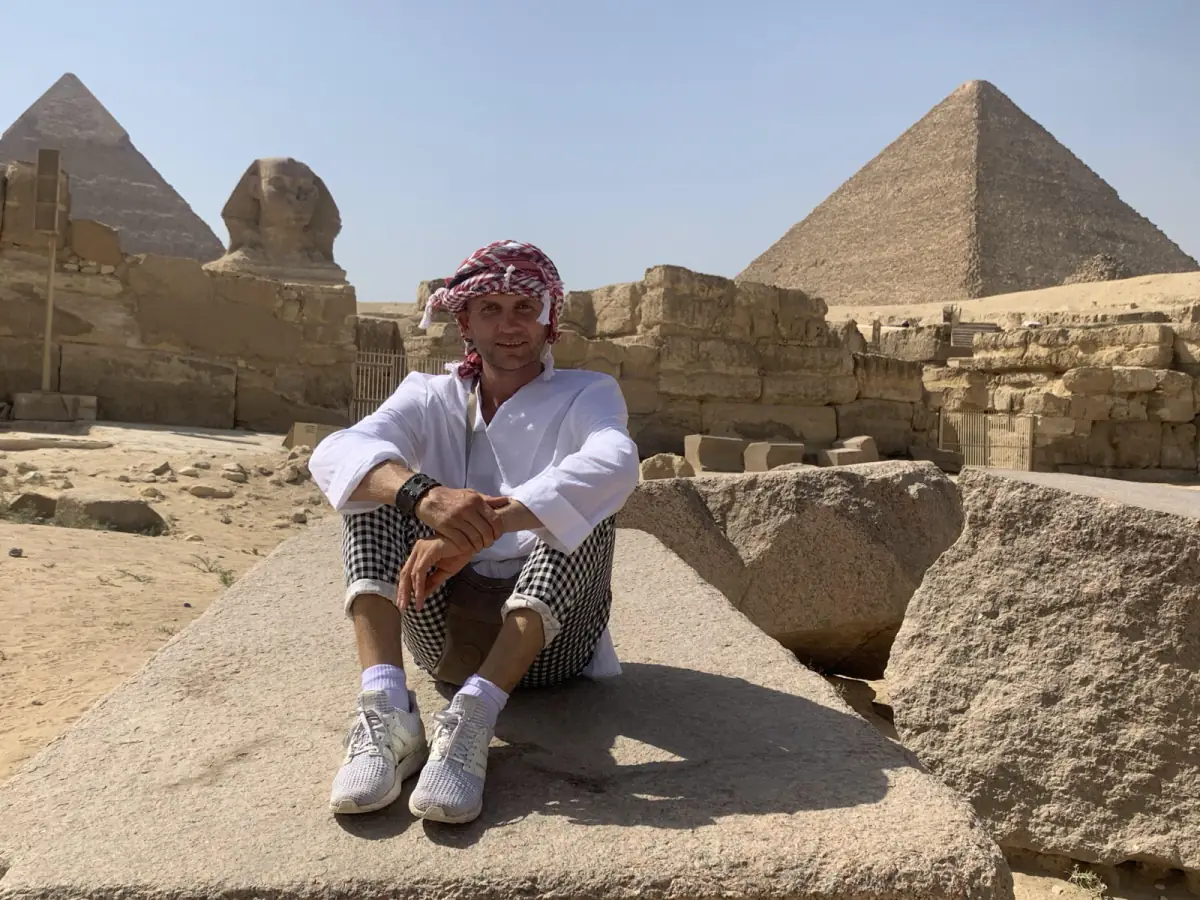
Walk the first section of the chain without getting up: scroll down — and the planet leads you from station to station, from the Giza Plateau to Karnak.
On the left — the station: its role in the chain, why it is here and when to go to it. On the right — the planet’s wireframe, with the path travelled glowing gold; below, the “where we are” line: coordinate, the station’s note, the node’s Gate. At Giza the camera descends to the very ground — the first three stations stand a few kilometres from each other — and towards Abydos it rises: from there the path goes south, along the Nile.
Station 1 · note Mi
The resonance generator of the Wheel; the launch of the chain
The point from which the work across the region begins.
When to go: dawn; night for the stars; midday is dangerous.
Station 2 · note Do
The First Laboratory; the birth of form (the tonic of the Egyptian block)
Transition along the chain: Saqqara (created the form) → Abu Ghurab (fill with light).
When to go: dawn; window Oct–Apr.
Station 3 · note Fa
The Platform of the Sun; receiving the Source
The only temple on the route dedicated directly to the sun, under the open sky.
When to go: dawn — the first ray on the benben (culmination); midday — full heat.
Station 4 · note Re
The Gate; reassembly out of chaos (the first station of the Nile section)
Transition along the chain: light → the gate and rebirth.
When to go: day — the Temple of Seti I; the descent to the Osireion — the culmination.
Station 5 · note La
The Node of Resonance; tuning
Transition along the chain: reassembly → tuning.
When to go: day — the halls and crypts; midday — the roof.
Station 6 · note Sol
The law of manifestation; the body in stone
Transition along the chain: tuning → law and body.
When to go: dawn — the Avenue/hypostyle; evening — the illumination.
Station 7 · note Sol
Cosmic order; manifestation
The end of the section; further along the chain — Edfu (manifestation → light over chaos).
When to go: dawn — silence; evening — the sound and light show.
Further on, the chain goes to Edfu, Kom Ombo, Aswan and Philae, across the Red Sea to Sinai and to Jerusalem — this is its continuation, and it is not part of the first section. On site this section is guided by the phone guidebook — open the chain in the guidebook →
The route is assembled not as a list of sights but as a chain of resonator stations. The eight-note limit is lifted here: the chain itself is an octave of a higher order, whose notes are entire node-octaves. The fractal of the canon works as intended: 8 → 16 → 32 → 64.
Each station has a film hook (a plot that can be filmed), a key artefact (what to see with your own eyes) and honest labelling: where there is verifiable archaeology, where a hypothesis, and where a beautiful legend that we do not pass off as fact.
The Wayfarer’s day does not end with the temple. Around each note there are five or more locations, chosen to match the element of the day.
The cluster formula: a temple (the sacred core of the day) + 5 or more locations around it — nature · culture · science · taste · mystery. The locations do not dilute the note, they orchestrate it. The formula is one for the whole network; below it is worked through on the same node as the passport above — seven clusters and 38 locations are assembled there, of which 33 are verified and five are a reserve for a deep tempo. The notes Re and Si stand on one mountain — at Pura Luhur Batukaru: the first water is taken at the source at the beginning of the ring, the second by returning to the same water at the end, so the cluster of the western highlands works for both. Mi is Besakih in its entirety, from the courtyards to the upper terraces. Goa Lawah, the cave temple where the sea meets the mountain, and Pasar Agung on the slope of Agung are held as the day’s reserve — in case the temple of the note is closed for a ceremony; Goa Lawah is also an optional trip for a deeper immersion. The clusters of Kailash, Belukha, Olkhon and the other nodes are assembled by the same formula, in order of readiness.
The rules of movement are part of the game, not a service manual. The road here is not a pause between temples but an interval of the octave.
The Wayfarer’s movement — the eight legs of the ring. Below, the route is broken down not by temples but by the road between them: from where, to where, on which day, by which road and where you spend the night. The names of the six key points stand as the author recorded them.
Travel times are guidelines, not a timetable: they are checked when a trip is set up, and the traffic in the south of the island can double any of the southern legs. The total length of the ring is ≈350–400 km.
Permanent infrastructure on a node: its own venues and the reception of groups. The centre’s eight stages are the same eight notes of the octave: the route is not duplicated, it gains a footing on the ground. Every location has three mandatory layers. The format is the same for any node of the network; the first centre is set up where the passport has been taken furthest, and after that — in order of readiness.
Above the eight stages stands a ninth, concluding block — “The Element of the Sphere”: it does not add a new note to the octave, but closes the gathered eight into a unity and sums up every stage passed. A participant’s access is an access level in the platform’s system, not a separate token: we do not create a second entity.
A node lives not by the map but by the people on it. Below are the four forms by which the network holds together on the ground between expeditions.
The network’s first offline node is set up where the author carries out the work himself. Here the map rests not on a diagram but on living people and the island’s real venues — the three pillars are named in advance.
Do you have your own centre, hotel, retreat venue or space for practices? The network’s nodes are not only mountains and temples: a living point on the map can be yours too. Map of nodes →
There is a map of the planet where the lines of force converge — natural nodes, science and living people. We invite your centre to become an Authorised Node of Planetary Coherence on this map.
What the centre receives: a flow of conscious people from the platform and from the app · the status and sign of a network node · ready-made meaning for its audience — meditations at the point, DSOT science, the Atlas of States, calibration of the Twin right at your place · co-creation: retreats, sacred journeys, live events of the network.
What is needed from the centre: to share the philosophy, to be an offline point of presence, to hold practices, to meet the standard of coherence.
We give visibility, meaning and the network — the rest you create. The brightness of a node on the map shows the centre’s activity and service.
The step depends on what is real: programmes completed and practices led. A person’s card shows the Tree of States without percentages, the facets that have manifested and a qualitative zone of coherence, not a score.
🔴 Two “Seekers” on one page are two different scales, and they must not be confused. The “Seeker → Architect” bar in the node passport is the state of the one walking the ring. The ladder above is service: what a person has learned and what they have led for others.
The network holds together through meetings, not marks on a map. Here are three things the platform can already do: show your code for an in-person meeting, keep a list of meetings and name the places where so many people have gathered that a meeting makes sense.
The in-person meeting code, the list of meetings and the map of gatherings are tied to your sign-in: without it the platform has neither your code nor your meetings. Gatherings are shown only as numbers — there are no names or coordinates in them, and there never will be.
The Earth is a living crystal with a nodal grid. At the points where it intersects, the connectedness of the environment is higher: nodal points of spatial-frequency resonance — that is where the alchemy unfolds. The quest goes beyond the screen: a phone at a planetary point — and the node comes alive. author’s model
The path has a finale, and it is not on the screen. Having passed through a chain of points, a person is admitted to the collective practice for the sake of which the whole map was assembled.
This is not one more meditation on the list. It is the final beat of the section: the gathered notes close, and for the first time the participant hears not their own point but the whole network entire.
The arc of the author’s text: a star portal above the crown of the head → a stream of light through the crown → a counter-stream from the crystalline core of the Earth, entering through the feet → the joining of the two streams in the chest → the human being as a living node and antenna → all the points of the planet in a single field and in one pulse with the heart of the Earth → the grid responds as a whole. the author’s meditation
Access is opened not by a purchase and not by a date in the calendar, but by walking the chain of points — in person or from home. The key here is the same as for the 🔑 secret centre on the Bali ring and for the hidden fermata inside a node: the path walked, and nothing but it.
The text of the meditation belongs to the author and sounds in his words, in full and without edits. The images within it live as images: they are not brought out onto the page as a separate claim and are attributed to nothing — neither to the Mineral nor to physics.
A major feature film — history, science and the game in one storyline. The viewer lives through a path: how an instrument that changes a person is born, why a person needs to restore the connection with themselves and with the Earth, and why this concerns everyone. The film is conceived as the global launch of the project — a point of entry for millions of viewers into the world of Sacred Journeys.
It is being filmed without a film crew and without actors — entirely with AI. Vadim Kovalev decided so, and it is of the same order as everything else here: a film that once needed an expedition of fifty people is made today with vision and precision. The Alchemist is played by the author himself: the face and voice on screen are an avatar of Vadim Kovalev, synthesised with his permission; where needed, he appears in person.
Without a film crew and without live actors: the film is assembled by means of AI.
This is the same decision that underlies the whole platform: technology takes off a person’s shoulders whatever gets in the way of doing the main thing, while the decision stays with the person. A film that once required an expedition of fifty people is made today with vision and precision.
This story has two heroes, and they did not meet straight away. The first is the Alchemist: he knows about the Mineral, about the sacred places and about the planet being built like a crystal. The second is the Author of the Game, a game designer at the peak of his craft, for whom everything works out and nothing has meaning. His own question goes like this:
“Everything we create must carry meaning. But what meaning can a game have if it does not open something new in a person?”
The Author of the Game · a storyline by Vadim Kovalev
One night he sees a vision: his own flat dissolves into an ancient temple, symbols of alchemy and sacred geometry emerge all around, and the Alchemist appears before him — to pass on knowledge about the sacred places of the Earth, about the crystalline grid of the planet and about the Mineral. And he tells him one phrase, out of which everything else will later grow:
“You are seeking meaning. Meaning is hidden in the very foundations of the universe. The planet is a living crystal, and you are its guide.”
The Alchemist to the Author of the Game · a storyline by Vadim Kovalev
In waking life they run into each other later — at an international conference on innovative technologies, where the Alchemist gives a talk on the link between sacred places and cosmic rhythms. The conversation continues in a café in an ancient city, and there the idea finally takes shape: the Alchemist’s knowledge plus game mechanics and augmented reality. Then comes the joint work: a laboratory, an office, the concept of a global quest through the sacred places of the planet.
Hence the structure of the platform. Science, the Game and the Journey are not three neighbouring sections here that someone decided to put side by side. They are one story: knowledge that became a game in order to reach a person on foot, not as a lecture. The final line of the two in this storyline is “we didn’t just create a game, we created a path to awakening”.
What kind of film this is, the author puts just as directly: “this is not an advert and not a report — it is an adventure film in the spirit of those stories about explorers that we all grew up on…”. The plot is carried by a quest through the sacred places of the planet — along the junctions of the crystalline grid.
Five scenes. The structure in which the film was conceived.
“Any challenge… is like stones that a true alchemist turns into gold”.
“Every difficult situation is an opportunity for inner crystallisation”: here the language of the film meets the language of the project’s science — self-organisation is the crystallisation of the personality.
“If a person once shows heroism, this lays the foundation for future heroic deeds”. Hence the dramaturgy: every deed of the hero is a step of crystallisation, not a decoration of the plot.
The author says it directly: “I would like to bring this message to the audience through film”.
The film is made with AI, but its hero’s path runs through the real nodes of the grid — the ones that stand on the map of this page. The game through them is open before the premiere: the nearest node and the first move are in the game.
If you have your own centre, venue or space near a node from the film — the expeditions have their own form for this, in the expeditions section. From there the conversation continues in person.
There is no teaser, and we are not naming a premiere date, but the author has been filmed and can be heard already now: forty-nine conversations, gathered into seven acts of the path, are on the platform and ready to play. Each comes with a summary and one practice; no registration is needed for this.
This is not the film and not part of it — it is another genre: a conversation, not cinema. But the language is the same, and the path begins in the same place.
This film is not a story about a stone. It is a story about an environment that awakens, and about the human being as a system that moves to a higher level. Exactly the same is explored on this platform — only here in the language of science, and there in the language of cinema.
Not an old man with a staff:
The travellers here are not old sages with long beards, but young, successful and beautiful people who, for all their outward success, find their greatest pleasure in knowing themselves, in nature and in unfolding their own abilities.
And the hero’s attitude to the material is named in the same place, in a single line: “The material as a consequence of the spiritual path” — success and prosperity are not the goal, but a natural result of the path and an instrument for it.
The finale of each episode is not a full stop but a door: “Teaser of the next location — an ancient temple in the desert, symbolising a new facet of their path”. The path through the nodes is built the same way: a point walked opens the next one.
The project is at the stage of script development and production. Leave your contact — we will send you the teaser and the invitation to the premiere first.
The teaser, the premiere date and a closed preview — for those on the list.
Vadim Kovalev puts it briefly: we do not sell goods — we provide access to the technologies of the future. Hence the vocabulary: the language of an online shop kills the mystery, and in this ecosystem things are called differently.
Both names live side by side, on the buttons themselves too: the familiar one — so that a person understands at once what will happen when they press, and above it the inner one — so that it is clear where they are entering. The second name does not cancel the first, it deepens it.
It is not a souvenir: the journey is walked together with it — this is a mandatory condition of participation. Eight levels, from 233 € to 6 765 €.
“Sacred Journeys” is a research game based on the DSOT picture of the world: the elements, the grid nodes, the Earth’s Crystalline Grid. What is testable and what is not is marked on the page itself with the traffic light, not hidden in a footnote. The temples of the route are active sanctuaries: a dress code, silence and respect for the rites are mandatory. The dates, programmes and terms of the expeditions are confirmed before recruitment opens; augmented reality and the offline venues are being rolled out in stages.
The game through the grid nodes is open already now — enter →
The journey leads through the nodes of the planet. The Path of the Atlas leads through sixty-four facets: eight parts of eight, each facet with questions to yourself and an experience, and what you have walked adds up to the reader’s crystal. Walk the Path of the Atlas →
Where this leads
On the road you look at your steps from the outside. The next step up is to see how these steps come together into one whole
The question you go to a place with, and what you notice along the way, are parts of one picture: body, attention, reactions. When they begin to coincide, this is what is called alignment; you can note it in your own series of observations at home too, after the road.
The ladder of five steps is shown above; next comes the third.