Self-Organization · DSOT
Matrices of Matter
The DSOT Book:
the architecture of the mineral matrix
You know your habits and reactions, just as you know what throws you off balance. What is harder to see is how all of it adds up to a system: why one reaction pulls another after it, and why the familiar image of yourself holds so firmly. Systems have laws by which order arises by itself, holds and falls apart. This book works through them on water and the crystal, and gives you a language in which you can ask yourself the same thing. Test it on yourself today. Notice which of your reactions sets off the next one, and then turn the focus onto attention itself, that is, onto what you are looking with right now.
In 1982, in an alloy of aluminium and manganese, researchers saw a symmetry that crystallography considered impossible, and 29 years later the discovery was awarded the Nobel Prize in Chemistry. From here on every claim carries a number, an instrument and a named boundary, and you can check any of them yourself.
The work on matter that you have opened rests on a short chain of five links. The Mineral is the material centre of the whole direction. Order that holds itself together is called self-organisation. In a person it shows up as coherence, that is, the alignment of body, attention, reactions and behaviour. This alignment shows itself in the person’s state, and the person observes that state himself. The last link is the study of consciousness. This page works through the second link: how order builds itself in matter and what it is measured with. Two pages tell about the neighbouring links: how verification works and where such work is read and defended.
Where the path begins: what you call yourself and where attention lookscollapse
You have already looked for this in books and practices, so we will say it briefly. What you call yourself rests on habitual reactions. Out of them forms a trace, an idea of yourself, assembled from the past in order to become happy, and only one who is can be happy. Awareness is, and it is the one thing that needs no proof. You are made of the same as everything around you. That all of this is one does not follow from physics: it is recognised when the focus is turned onto attention itself, the boundary wanes and you are already looking from the shared. This needs no special strength, it needs a habit. Several times a day, take attention off a reaction, find your attention and turn the focus onto it. Then the world stops being a background, and you are the one who makes this observation. Why it works is what this book works through: in alignment, noise dies down by itself.
Thus begins a return to your original nature. While the observer and the observed remain two, the transition is still ahead: it lies where the two no longer remain. The first two steps you test by observing yourself; the third is recognised in experience. Bringing attention back time after time, you gain a support that does not depend on the day, and with it quiet, evenness and a taste for life. Below, the same is worked through step by step, with a support under each step.
The subject here is a return to your own nature. No new state has to be acquired, and the stone here is also only a condition: what is already in you remains to be recognised and gathered. In this state the parts no longer pull in different directions: the body, the course of thought, the feelings, the cell, the course of the day and, beyond that, the shared field. It rests on the body’s water–mineral medium, and the alignment within it connects one thing with another. People often come here with no strength left by evening, but the main thing lies deeper: the lower door is open and leads higher.
Start with the bridge: from the string of Pythagoras to the Mineral →
A fundamental work at the junction of water biophysics, geoecology and the technologies of directed self-organisation — the language in which DSOT describes living systems. It brings together the constitution and the technical description of the project.
Why self-organisation, and why now — our subject: the environment in which a person awakens →collapse
Why self-organisation — and why now. With the arrival of artificial intelligence, the human environment has changed irreversibly. Part of knowledge, decisions and connections now takes shape in systems that learn and rebuild themselves. The research question here is how a person can preserve and raise his own level of organisation within such an environment. In this frame AI speeds up the work, while decisions remain with the person. Hence our subject — the environment in which a person awakens: its conditions can be described, measured and directed.
The living rests on order: on how aligned the rhythms are and how well structured the water around the cells is. This book is about how such order arises and whether it can be induced from outside. Below, the same is said in the language of physics, with numbers, instruments and honestly named places where no one yet has an answer.
To get a feel for what order is meant. In a cubic centimetre of crystal — the volume of a sugar cube — there are about twenty-seven thousand billion billion water molecules built into the structure itself. The number describes the scale of the structure, that is, how many places it has. How much is written into those places, it does not say.
How we know this →collapse
Both numbers are counted from one reference edge of the unit cell and are reproduced in three lines: cells in a cubic centimetre ≈ 5.6·10²⁰, molecules of structural water in the same centimetre ≈ 2.7·10²². How the number of cells is counted — on the “Technology” page →
What these numbers do not say. They describe only the number of ordered places in the structure. The capacity ceiling by number of places (tens of exabytes per cubic centimetre — as much as the entire internet of the Earth transfers in three days: world traffic ≈ 8.8 ZB per year, ITU estimate 2025 → ≈ 24 EB per day, 70 ÷ 24 ≈ 2.9) is also only a ceiling: it asserts nothing about recording. What exactly is recorded, and whether it survives dissolution, remains an open question for now. It is worked through further down the page, together with the condition under which our model will turn out to be wrong.
The research premise of this work is as follows. The organism is better described as an open liquid-crystalline information system, continuously tuned by the planet’s fields, than as a chemical vessel. “Liquid-crystalline” means that the water in it is ordered almost as in a crystal and at the same time remains fluid. The premise obliges us to measure orderliness and the alignment of rhythms, with concentrations in second place here. It also has an outcome under which it is wrong. If the orderliness of the medium is destroyed and signal transmission does not change at the same chemical composition, the description will have to change.
Three pillars of the book · water, topology, the operator protocolcollapse
- 01The physics of the EZ phase of water. A hypothesis of how the fractal matrices of the mineral may bring cellular water into a more ordered liquid-crystalline state.
- 02The TER technology — the Topology of Ecological Resonance. A model of a local environment of self-organisation — from a wearable “cocoon” to spatial anchors.
- 03The Operator Protocol. An engineering approach to observing the state through heart rate variability (HRV).
The environment in which a person awakens is the foundation of our science. Hence also the acceptance criterion for the platform itself: if knowledge cannot be assembled into a coherent, readable system, we have no right to speak of self-organisation. Form here is part of the claim itself.
HRV, heart rate variability, shows how differently the intervals between heartbeats last. It can be taken without a device on the body: twenty seconds in front of a phone camera. Live measurement by camera → On a computer, the camera itself tunes the sound to the spread of the rhythm — this is the station.
Briefly about the stone, at length about connection
There are days when everything in you goes in one direction. Breathing does not argue with the heart, thought does not chase itself, conversations come without effort. In the evening you will not recall a single feat of yours, and yet the day has turned out the best of the month.
Such a day has a cause, and it is called alignment: the parts stop pulling in different directions and begin to move in time. The main thing in alignment is connection: it connects everything with everything, and each next layer links the one below it with the one above it.
It is precisely this state that is offered here, and the stone serves as its condition. A person acquires nothing new: he returns to his own nature and remembers what is his own, and this path has no other final goals. It is walked step by step; there is no need to wait for it.
The body. The out-breath goes out by itself; you do not need to let it out. Inside it is light and empty at the same time, and this emptiness is not frightening. Ancient texts call such a state by one fused word bde stong, lightness-emptiness. Alignment of the body is easy to recognise. Breathing and heart move in time, and you do not have to hold that time, like a metronome that no longer needs a push.
The course of thought. Thought stops chasing itself. Attention holds by itself, without your effort, and you recognise it as a return of what is yours; there is no sense of achievement here. There is a word for this, sahaja, “born together”. Alignment of the course of thought shows like this: thought and attention move in harmony, like a swing already in motion that does not need pushing — it is enough not to get in its way.
The feelings. Praise and silence stop tasting different. Different things take on one taste, in Tibetan ro snyoms, even taste. Breakdowns remain, but the way back to evenness becomes shorter. What is measured here is the time of return; mood does not enter this count. Alignment of the emotional sphere gathers what used to tear the day into pieces. So a candle burns in a room without a draught: the flame still trembles, but straightens faster.
The cell. An even state no longer has to be extracted from people and events. In the formula “being — knowing — joy”, joy is named the third name of the ground itself, ānanda, and such a name can be neither earned nor lost. Alignment of the cellular space brings the layers of the body’s work into one time. The difference here is as between a pot that has to be heated all the time and one that has already come to the boil.
Life around. The day becomes tasty, and you recognise events before you have time to explain them. For this moment the tradition has a word from the language of food and theatre: camatkāra, tasting, a short “ah!” when the taste is recognised. Alignment of the life space shows in the course of the day. Coincidences come in rows, the world stops being a background and links together what seemed random. You are the one who makes the observation. The order here is the reverse of the habitual one: first the state comes, and affairs and circumstances fall into place after it, and you can check this against your own day. The course of the day can be heard like a clock in a quiet room: while it is noisy around, its ticking cannot be made out.
Focus on attention itself. Between the layers stands one action, the only one on the whole path: gathered attention. You take the focus off a reaction and turn it onto attention itself, and attention is at the centre, while the reaction moves to the edge. Attention is not applied to anything and remains when the reaction has already passed. Alignment of attention requires no effort: it holds by itself as soon as the interference is removed.
The shared field. On the sixth layer the edge between you and the rest of the world disappears. You and the world pull one load, and the ancient image for this is a peasant one: zung ’jug, “yoked together”, two oxen in one harness. It comes as wonder; you cannot reach it by inference. Wonder in Sanskrit is vismaya, and in the “Shiva Sutras” it is named one of the stages of the path. From the shared space, one is looking.
The sixth layer cannot be derived from the first five. The five layers are described as alignment, layer by layer. The sixth is recognised. Where description ends, ancient texts put wonder. Write “hence follows unity” — and you get a logical inference instead of experience.
About the stone — three lines, and no more is needed. The Mineral gives the body one condition: alignment, in which the layers begin to converge by themselves. It sets the condition, and the result is put together by the system itself: the mineral removes what was pulling the parts in different directions, and from there alignment connects everything with everything. So a pinch of salt changes a glass of water: the water remains water, but the condition in which it holds itself changes.
Two doors and the staircase between them. Behind the lower door are chaos in affairs, tiredness by evening and the heavy decisions of the day, and this is what people most often come with. Behind the upper one is your own nature and merging, when from the shared space one is looking. The lower comes along the way; the main thing lies further. Between the doors stands a staircase; it is climbed step by step, layer by layer, and each step rests on the previous one. Without alignment of the body, gathered attention does not hold. Without gathered attention, the focus cannot be turned onto attention itself. How deep to go, each person chooses for himself.
Where this meets science. Order that arises by itself is studied by science. Prigogine showed how it arises in open systems, Haken described how the parts of a system come into one time, and in 2022 the Nobel Prize in Physics was awarded for experiments with entangled photons. These works say nothing about the mineral. These works show something else: alignment is measured with instruments, and further down the page both the instrument and the boundary are named.
Six layers and six keys of antiquity — a table of sources →collapse
Each row gives first what is said in the source and then how it is recognised today. The layers were stitched to the keys by us; the meanings of the words are taken from the sources.
① Alignment of the body · Tib. bde stong — lightness-emptiness in one word. In the source, bliss and emptiness are named as one experience. Today: the out-breath goes out by itself, light and empty at once, and the emptiness is not frightening.
② Alignment of the course of thought · Skt. sahaja — born together. In the source, the state is born together with the person: practice does not produce it, it removes the interference. Today attention holds by itself, and this is a return of what is yours.
③ Alignment of the emotional sphere · Tib. ro snyoms — even taste. In the source this is one taste in different things, and it is not confused with indifference: success and failure stop tasting different. Today praise and silence no longer run the day, and the time of return to evenness becomes shorter.
④ Alignment of the cellular space · Skt. ānanda — joy as the third name of the ground in sat-cit-ānanda. In the source, joy stands as the name of the ground itself and is not regarded as a reward for practice: it can be neither earned nor lost. Today an even state no longer has to be extracted from people and events.
⑤ Alignment of the life space · Skt. camatkāra — tasting, “ah!”. The word came from the analysis of art and means the moment when the taste is recognised. The tradition took it from the language of food and theatre; it has no temple meaning. Today the day becomes tasty, and events are recognised before they are explained.
⑥ Alignment in the shared field · Tib. zung ’jug — yoked together · Skt. vismaya — wonder. In the source this is a harness: two oxen in one harness pull one load. Wonder in the “Shiva Sutras” 1.12 is named among the stages of yoga; it is not regarded there as a side feeling. Today you and the world pull one load, and this comes as wonder.
All six are stitched together by the word sahaja: no stage is produced by effort; at each one, only the interference is removed. We do not name lineages of transmission or initiations, and we do not make a school’s doctrine our own claim.
Why this science matters to a person, not only to the laboratory
Most likely you do not run experiments or read scientific papers. Yet you live by the same rules as water at the cell wall and the frame of the planet: order holds as long as the rhythms are aligned. That is why the work has an applied side, and you test each of its supports by your own observation.
- Seeing your own processes. You notice what is going on in you right now, in what rhythm and how aligned. General words about yourself give way to observation.
- Alignment with nature. The same water, the same rhythms and the same geometry recur across thirty orders of magnitude, and a person is one of the parts of this system.
- Decisions in life and in work. A system is not talked into things; it is given conditions. A small precise move at the moment of transition gives more than constant pressure.
- Thinking by a rule instead of a memorised answer. When you see the mechanism, you see your pattern from the outside, and it stops being the only move available.
- Science that serves life. Knowledge is brought to the point where it can be used in life.
- A shared movement that you can join. The work goes on in the open. Measurements, protocols and chapters lie on this same platform, and anyone can read and check them.
Checking is simple: look, compare and draw your own conclusion. Further down the page are eight chapters on how order arises and what holds it, and each one names its support.
What you get from this
One and the same geometry assembles anew on five steps in a row: in the water molecule, in the water cluster, in the crystal, in the frame of the planet and in the galaxy. Between the outermost steps lie thirty-odd orders of magnitude, and the set of forms recurs. Hence a practical conclusion. To change the state of the living, one works with order, that is, with how aligned the rhythms are and how well structured the water around the cells is.
This order can be induced from outside, and it is tested on the mineral. Eight levels, each next one a development of a higher class: from €233 to €6,765. As a separate position above the staircase — “Wholeness”, €10,946.
If you do not feel drawn to buy yet, read on. Further down is the work itself: eight chapters on how order arises, what holds it and where no one yet has an answer.
In nature everything — from the structure of the water molecule to the build of a galaxy — obeys unified geometries and laws of self-organisation.
DSOT — a unified language and instrument: it helps a person tune his inner environment and space to these universal laws of nature.
Development is a sequential increase in the level of organisation of a system.
What stands behind each linecollapse the explanations
The page is built in layers. The essence stands at the top, and the depth opens on a click: under each fold lies a full analysis, and not a single line has been removed.
Where to go straight away · 21 short routes through the pagecollapse the routes
On five steps, with thirty-odd orders of magnitude between the outermost of them, one set of forms recurs. The scene rotates by itself, and you can also drag it with the mouse or a finger and switch the step.
Why the statuses of the steps differcollapse
Each step has its own honest status: three of the five rest on reproducible science, one is under research, one remains a geometric hypothesis of 1973. Different statuses within one picture are what make up that picture.
One law assembles the molecule, the organ and the galaxycollapse
“a person and his connection with another are exactly the same law by which molecules assemble into a crystal lattice, cells into a living organ, and stars and planetary systems into galactic arms”. One and the same order of connections runs through all levels of being, and the scene above shows exactly that.
The same law on three levelscollapse
Molecular: a single atom forms no compound. A bond is born where there is a deficit and a readiness to share electrons. The breaking of a bond is a change in the entropy of the system, that is, of the measure of its disorder: the temperature or pressure of the medium has gone beyond what the lattice can withstand. There is no grievance in it.
Human and cosmic: two people at one task form a unit cell. The true centre of a system holds the field by its mass and the precision of its rhythm; it needs no coercion, and the rest revolves around it by itself.
Giving up anthropocentrism: a person is an elementary node of a complex network through which flows of energy, information and time pass. The view changes, while human experience stays in its place: the law is shared, the experience is one’s own.
The boundary of the method, without which it breaks itself: what must coincide is relations, not images. A similarity must predict; explanation after the fact does not count. A transfer must reproduce in another person. The limit where the similarity ends is named aloud. An analogy that does not pass these four checks remains decoration and does not become a support.
The scale differs — the law of assembly is one.
What holds the many together — one question on two scales
A hundred people in a square are a crowd. The same hundred people in a choir are one voice. No people were added or removed; only the alignment with which they act has changed. Order rests on the alignment of the parts, their number decides nothing here, and this is true of the crystal, of the body and of the planet.
Micro and macro are one. One law holds the many together on any scale, but it is embodied in different ways. In a lattice it is the geometry of the bonds between atoms, in the heart it is rhythm, in a conversation it is the timing of breath and speech. Different mechanisms do not contradict the law, they manifest it, and the whole is nowhere assembled out of “each on its own”.
Beneath this lies the physics of the twentieth century. Mass and energy are one quantity in two forms. Almost all the mass of the matter the body is made of falls on binding energy, that is, on the energy of the interaction of quarks inside protons and neutrons, while the masses of the “bricks” themselves give only a small share of this mass. Nature here is one: it is one fabric, taken at different densities. Field, air, water, stone and bone differ in the density and connectedness of one and the same thing. The crystal is the most ordered pole of this fabric: its bonds are set by geometry. The person is the most mobile one: his bonds have time to change. Matter is energy that has a form. Life is a form that can sustain itself. A person is a form that can notice itself.
This has a name. When the alignment inside coincides in phase with the alignment outside, it is coherence on two scales at once. In scientific work it is named more strictly — cross-scale synchronisation: processes of different scales are coupled to one another and run in an aligned way. So two pendulums on one beam come into a shared time by themselves over time. This is studied by the theory of coupled oscillatory systems.
And it is tested by a number · the order parameter, Huygens’ beam and the limitcollapse
The order parameter shows how closely the phases of a multitude coincide, and it can be taken with a single sensor, without reaching each element. Pendulums on a shared beam come into a shared time through barely noticeable oscillations of the beam itself, and Huygens saw this as early as 1665. An external steady pacemaker aligns even elements that are not connected with one another at all. The limit is named there too: excessive synchronisation destroys function, so the measure looks for alignment and has no need of sameness.
Lattice. The atoms of a crystal are held by the geometry of their bonds. Properties are set by the whole structure of the carrier; a single formula is not enough for them. solid-state physics
The boundary with water. At the surface of the carrier, water orders itself in layers, and this is reproducible surface physics. How far the order extends into the bulk is decided by measurement. surface physics
Rhythms of the living. Heart, breathing and regulation run in time or out of step. For misalignment the organism pays with the cost of compensating for it, and indicators of this cost are taken by instruments. indicators exist
The planet’s environment. Without air and without the Earth’s electromagnetic environment physiology does not work, and this is a literal condition of life. condition
A network of points. The planetary lattice of 156 + 1 nodes is a network of places named one by one. On this scale the same question is put to a map. DSOT map
The whole. The main open question of all knowledge is how experience itself is born from the work of matter, and the staircase of scales leads to it. open question
Hence the mineral’s place in this picture: it works as a double linkage. Downwards it leads to order. The Mineral holds a reference geometry in which a multitude of parts runs in alignment, and this is expressed by a number. Upwards it leads to attention. When there is nothing to hold, attention stops going into holding “oneself” and becomes wide, and this is seen in deeds; sensations are not enough here. The first we calculate; the second you test yourself. What is measured, what is calculated and what is open is set out in section 04c-bis.
The staircase reads the same from bottom to top and from top to bottom, and on each step one question is asked: what holds the many together here? Each step has its own test and its own status. The conclusion of one step does not carry over to another, a step cannot be skipped, and none of them proves the next.
How to read the statuses of the staircase · what tests each step and where the boundary runscollapse
Established — there are reliable independent data; you can rely on them. Under research — there is a signal, and research is going on. Open — no one has an answer yet, and this is said aloud.
The mechanism on each step is its own, but the question is shared. It makes sense on all seven steps, and on none of them is the answer “each on its own”. The physical definition of alignment from the first step does not carry over to the fifth and sixth as proof. When we call a person’s collectedness coherence, we are speaking our own language, and a measurement from the first step does not carry over here.
On the second step, the layers of water at the surface of the carrier are reproducible, and how many of them go into the bulk is decided by measurement. On the steps of the organism, the psyche and awareness, the platform has an observational circuit at work: a signs diary and voluntary self-report. It prescribes nothing to a person and shows him his own record.
The scientific bridge of the sixth step is this. The feeling of a separate “I” that retells itself and wanders in thought is connected with the default mode network of the brain, that is, with those of its areas that switch on when a person is not occupied with anything. In experienced practitioners, the main nodes of this network quieten during practice, and more strongly than during an ordinary active task. In the work of the brain this is an observable trace, while how experience itself arises from this work remains an open question.
The mirrors of Fazang · in each, all the otherscollapse
In the “Avatamsaka Sutra” there is an image: a net with precious stones in its nodes, and in each one all the others are reflected, and in those reflections again all of them. The monk Fazang (seventh–eighth centuries) showed this simply: mirrors in a circle, one lamp in the middle. No mirror became poorer because the others are in it.
The laboratory says the same in its own language. Break a hologram, and each fragment will show the whole scene, only more softly. The record in it keeps the ratio of phases, and this ratio remains in any piece. For holography Gabor received the Nobel Prize in Physics in 1971.
Hence our move. The nodes of the network for us are the planetary lattice of 156 + 1 nodes. The stone in which the order of the whole holds is the mineral of your level. We count alignment through phase, as with a hologram. When the parts move in time, each one gains, and none gains at the expense of another. We take the image from tradition; the language and the measure we keep our own.
Here participants tell about their experience themselves: these are self-reports of individual people, in their own words.
“For me personally, a question that had tormented me for a long time and very much has finally been resolved. And the second interesting thing... Dreaming has opened up, and the ability to drop into the deepest meditation for a few seconds, which is quite enough to receive instant answers to all questions…”
“…I felt that energy really was flowing, and I felt very good. I feel really focused and structured. And it was very, very powerful…”
On the reviews page, 34 texts are given in full and without a single edit — the difficult ones included. All 91 reviews of the Mineral: 61 stories and 30 video and audio recordings →
00 — What DSOT is
Why it works for any systemcollapse
This language describes the development of a system regardless of its nature. If a system develops, it has principles of organisation, and principles of organisation can be researched.
What can be described in this language — from a crystal to a statecollapse
The language here is assembled from principles. A term fixes one object, while a principle transfers between fields, so one and the same notation serves both for a crystal and for a community.
Five clarifications for those who have already met similar wordscollapse
- it isa language of description — a precise record of how a system is built and how it changes
- it isa set of principles, which transfer between fields: one and the same notation serves both for a crystal and for a community
- it isTechnologies in the abbreviation — knowledge of what to change in the conditions of a transition
- it isa working instrument of the researcher — it is used in work and corrected by the result
- it isa testable description: on a living system it either holds the system or diverges from it
A theory rests on proof; a language rests on the precision of description. DSOT is a language, and it is simple to test: take any living system and try to describe it with this notation. The description either holds the system or diverges from it, and that is where the test begins.
In one line: where exactly DSOT works between the sciencescollapse
DSOT works between the sciences: where physical chemistry, biophysics, complex systems theory and sociology describe one and the same regularity in different words. It replaces none of them.
How this differs from Bertalanffy and Haken · five levers with which a system is tunedcollapse
A full answer to an academician’s questioncollapse
Bertalanffy described the open system, Haken the order parameters, and this work rests directly on both. The difference is in the task: general systems theory and synergetics answer what a system is and how order arises by itself. DSOT answers the next question: what exactly to change in the conditions in order to raise the probability of a transition.
That is why what we have here is an applied instrument of control and design. Its five control parameters are set as engineering levers, and each has its own physical nature of action and its own class of technologies. Hence also the letter T in the abbreviation: Technologies, that is, technologies, not Theory, that is, theory.
O — degree of organisation · M material matrix-carrier (the mineral is a particular case) · S spatial configuration, that is, geometry · E energy flux density · I information vector. The public notation of the model is one and the same in the showcase, in the museum and in the books. Below are the five control parameters of the scientific core, and for each the quantity and the unit in which it is measured are named.
The public notation has no R and B. The public notation does not say when the action is applied and why the resulting state is retained. Both quantities stand in the core above, with a unit and a measurement procedure.
Scientific deep divea system open to flowscollapse
Scientific deep diveorder parameters and leverscollapse
Scientific deep divefive levers and a marker of statecollapse
The full notation of all three levels of the model, the eight concepts of the dissertation and their reduction to five parameters are in section 04 · The DSOT taxonomy. The full list of technology classes and the seven generic lines are there too.
Sources of the sectioncollapse sources
The source of the five negations and of the definition “research language” is the introduction to V. Kovalev’s book on the facets of the crystal (verbatim; the abbreviation is given in the spelling DSOT). The formula “between the sciences” rests on Axiom 7 of the Constitution of the science of self-organisation (below, section 03c): “One and the same fundamental regularities can manifest themselves in systems of different nature… It is precisely the search for these universal regularities that constitutes the subject of the present discipline.”
01 — Problem · Solution · Instrument
Expand · three cards: what is wrong, what is proposed, what we work withcollapse section
Loss of coherence
The work proceeds from the view that the urban environment and the electromagnetic background can disrupt the natural structure of the body’s aqueous media. The system then drifts from order towards noise.
The topology of resonance
TER, the topology of ecological resonance, is a model of a local space of self-organisation. In it a person’s inner environment is considered in attunement with the geomagnetic frame of the Earth.
The mineral matrix
Kovalev Mineral is the physical carrier of a fractal matrix. It is studied as an epitaxial “template” for aqueous media, that is, as a pattern by which water at the surface lines up in layers.
01b — The forbidden symmetry · quasicrystals
In 1982 Dan Shechtman saw in an alloy a form that crystallography considered physically impossible, and for this discovery he was awarded the Nobel Prize.
What our letter G has to do with it — and why the claim rests not on uscollapse
This page names geometry an independent control parameter. It is the letter G in the core of control parameters, and in the public notation it stands as the letter S, spatial configuration. The claim is strong, and it rests on someone else’s discovery: in 1982 matter showed a form that crystallography considered physically impossible, and this discovery was awarded the Nobel Prize.
Do it yourself: bring the slope to the golden ratio and see the repetition disappearcollapse the scene
This mechanism can be checked by hand. Draw a line through an ordinary periodic lattice and bring its slope to the golden ratio: periodicity will disappear before your eyes, while order will remain. This is how nature got round the prohibition.
Computed on the spot, not drawn: the lattice nodes are selected by the strip and projected onto the line in real time. The ratio of the two lengths is shown as the calculation produced it.
Six facts of the forbidden symmetry · 1982 · Nobel 2011 · the golden ratiocollapse
the fact in fullcollapse
the fact in fullcollapse
the fact in fullcollapse
the fact in fullcollapse
the fact in fullcollapse
the fact in fullcollapse
Expand section · six facts, the author’s interpretation and the entrance to “The Bridge”collapse section
Why this fact stands on our page — and where someone else’s discovery endscollapse
“Dan Shechtman’s quasicrystal looks like a ‘forbidden anomaly’ in our 3D world only because we see just its 3D slice.”
Analysis: what follows from this and where the boundary iscollapse analysis
The honesty table above opens with the line “structure determines properties”, the only line with a green label, and the whole construction rests on it. The quasicrystal is the weightiest known case of this line: its composition is ordinary, but its behaviour is different, because its configuration is different. That is why geometry may legitimately be considered a settable quantity G, separate from the chemistry of composition.
The second conclusion is methodological. Fivefold symmetry was prohibited by an incompleteness of description, while nature itself did not prohibit it. The theorem was correct, but it spoke only of periodic lattices, and other structures can be ordered too. The “forbidden” geometry turned out simply to be under-described. Axiom 8 requires the same caution of us: any proposition remains open to refinement.
What we take from this. The Mineral is not a quasicrystal, and the prize belongs to Shechtman. We openly take one thing from here: geometry can be set; it does not reduce to a consequence of chemistry. This is a recognised topic of solid-state physics. The section “The author’s novelty” is built the same way: what belongs to others is named as theirs, and what is our own is shown in a separate line.
The Bridge has already been built — by the author, not by us
This page shows the architecture and the foundations. The whole arc, from one string divided in half to the Mineral, is unfolded by a separate entrance.
The whole arc point by pointcollapse
The quasicrystal stands as one point of a continuous arc, which the book “The Harmonics of Creation” leads from its first line: the monochord of Pythagoras → the Platonic solids → Shechtman’s quasicrystals → the E₈ lattice and superstrings → the quasicrystal as a three-dimensional slice of a six-dimensional one → DNA → the Law of Octaves → Haken’s synergetics → the technologies of directed self-organisation. The author’s own words: “In this work we shall travel the full path: from the monochord of Pythagoras and the Platonic solids — to the 8-dimensional symmetry of Ramanujan’s modular functions and superstring theory… to the practical physics of self-organisation”.
Sources of the sectioncollapse sources
Source of the section: V. Kovalev, “The Harmonics of Creation” — Part I, chapter 4, §4.2 “Dan Shechtman’s Quasicrystals: The Forbidden Symmetry and the Golden Ratio” (1982, Al₆Mn, 5- and 10-fold diffraction, the crystallographic restriction theorem, the Nobel Prize in Chemistry 2011, the Penrose tiling and φ, icosahedra and dodecahedra at the lattice nodes) and Part II, chapter 7, §7.3 (the cut-and-project method, Dov Levine and Paul Steinhardt, 1984; the lattice Z⁶ ⊂ R⁶; an irrational angle of inclination with tangent φ). The scene computes the cut and the projection on the spot by this same algorithm — the picture is not decorative but computed. The link to the parameter G is ours.
02 — What the work reveals
Expand · three lines of the work: thermodynamics, epitaxy, fractalscollapse section
The thermodynamics of order
TER is considered as a thermodynamically open system that exchanges matter and energy with its environment: an “oasis of coherence” in a noisy environment. What is discussed here is how entropy, that is, disorder, decreases in one place.
Epitaxy as a model
The contact and non-contact action of the mineral on the cluster structure of water is described by a physical model of the process.
The mathematics of fractals
The chapter explains why icosahedral–dodecahedral structures (the Platonic solids) are considered to underlie both the clusters of water and the geoframe of the planet. In this way the human microworld and the macroworld of the Earth are tied into a single knot.
02b — The architecture of the work · eight chapters
The work is assembled into one line of reasoning: each part answers the question posed by the previous one.
Four questions from which four parts grewcollapse
The first asks what is wrong with the environment, the second — by what laws order arises at all, the third — what a material instrument of research can be, the fourth — what happens when the same laws are tested on the scale of a community.
Expand section · the eight chapters of the work, what each is aboutcollapse section
The eight chapters of the work · what each is about, from the entropic nosedive to the economics of coherencecollapse
Statement of the problem: why the environment of the twenty-first century reduces the ability of living systems to extract order.
what the chapter is aboutcollapse
Evolution is described as the ratio of entropy and negentropy, that is, of disorder and order. Living matter takes order from the environment and gives disorder back to it, and this formulation goes back to Schrödinger: “what an organism feeds upon is negative entropy”. The main move of the chapter: a technological environment with dense building, destructured water and an electromagnetic background is considered as noise that reduces the availability of order.
what the chapter is aboutcollapse
Blood, lymph and intracellular water are considered as structured media. The support of the chapter is the exclusion zone at hydrophilic surfaces (the EZ phase): at a wettable surface, water lines up in an ordered layer, and this phenomenon is measurable. The thesis of the chapter: without taking into account how water clusters are built, the biochemical description remains incomplete.
The core of the work: how order arises and what it can be directed with.
what the chapter is aboutcollapse
Order cannot be imposed by direct control, but boundary conditions can be created under which it arises by itself. The support is the non-equilibrium thermodynamics of I. Prigogine (dissipative structures) and the synergetics of H. Haken. At a bifurcation point, that is, at the moment when the system chooses one of its paths, a small precise action changes its trajectory.
what the chapter is aboutcollapse
The chapter introduces the control parameters of the model: frequency range, geometry and topology, rhythm and temporal cyclicity, information vector, and also the material carrier-matrix M. In the current edition of the model, frequency enters into rhythm R, the set of parameters is written as R · E · I · G · B, and the public notation as O = f(M × S × E × I). Both notations are unfolded in the section “The DSOT taxonomy” below.
An instrument of research — and the boundary of what can be asserted about the instrument.
what the chapter is aboutcollapse
The chapter examines the crystalline topology of the prototype and the model of epitaxy: a layer grows on an ordered substrate, and the substrate sets its orientation. Epitaxy is an established branch of physical chemistry and materials science. The transfer of this model to biological aqueous media remains a subject of research. The Mineral enters the chapter in one role: as an organisational template and a research instrument.
“…It is an organisational template. From the standpoint of surface physics, the interaction of the mineral complex with the liquid media of the organism takes place according to the principle of epitaxy. Epitaxy is the regular growth of one crystal on the surface of another, when the structure of the substrate fully determines the spatial orientation of the growing layer. <…> On entering the aqueous medium of the organism, the structured mineral complex begins to play the role of a ‘microscopic blueprint’. Water molecules, on contact with the highly ordered surface of the mineral, instantly rearrange themselves, copying its ideal spatial geometry. Chaos recedes. <…> This is the world’s first reproducible physical prototype, created <…> for the total calibration of the phase state of the biosystem.”Vadim Kovalev · “Fractal Matrices of Matter”, chapter 5
The author’s scheme, in the same place, in three lines: the liquid medium of the organism (chaos) — the molecules are disoriented → the matrix of Kovalev Mineral — an ideal crystal lattice → the structured medium (order) — epitaxial alignment of the molecules. The key property lies with the mineral itself: its lattice holds the standard of order and creates coherence, and the liquid crystal of water, on meeting this standard, returns to its original symmetry. The transfer of this model to biological media is a subject of research of the Institute: this is how Vadim Kovalev describes this chain, and the verification programme begins with it.
what the chapter is aboutcollapse
Heart rate variability (HRV) is a marker of autonomic balance, that is, of the equilibrium between the modes of tension and rest, and it is taken by an instrument. This instrumental tradition goes back to the work of R. M. Baevsky. The laboratory’s observations here are exploratory: sample size, control and external replication will make them proof.
“How do we check that self-organisation has taken place? We have completely excluded the subjective factor from our experiment (‘it seems to me, I feel better’). The only objective judge in the DSOT system is heart rate variability (HRV). The heart is the main oscillator of the organism. Its rhythm is never strictly monotonous; the intervals between beats constantly fluctuate, reflecting the finest interplay between the sympathetic and parasympathetic nervous systems. High variability (high SDNN and RMSSD values) indicates that the biological crystal is plastic, adaptive and in a state of negentropy. Low variability (a hard, rigid rhythm) is a marker of systemic chaos and of the imminent exhaustion of resources.”Vadim Kovalev · “Fractal Matrices of Matter”, chapter 6
What matters here is not only the model but also the rule of verification: the author himself refuses to count a participant’s sensation as proof and moves the dispute into the domain of the instrument. Our measurement programme is subordinated to this same rule — the section “What we measure it with” below.
Testing the same principles on the scale of a community.
what the chapter is aboutcollapse
The laws of self-organisation are formulated as universal, from particles to cells and to communities (Axiom 7 of the Constitution). The author’s working chain: instrument → person → the environment around the person → network. A participant is a node of coherence: a unit that increases the alignment of the connections around itself.
what the chapter is aboutcollapse
Statement of the question: whether it is possible to build an economic circuit in which reward corresponds to the amount of order brought in rather than to the amount of expansion. This is a research question: the model of the economic circuit is set out in a separate document.
Two chapters by the author — on the substance and on light in its lattice. They are unfolded below, in sections 03-quart and 03-quint.
what the chapter is aboutcollapse
How a sample is obtained: a cascade of controlled iterative recrystallisations, the octahedral habit of a highly symmetric lattice, seed transfer, isomorphous substitution by microcomponents, and the anchor H₁₂ — twelve water molecules built into the lattice. For Vadim Kovalev this is “a living, evolving technology”, not a static recipe.
what the chapter is aboutcollapse
Light in an ordered medium: the photonic band gap, liquid-crystal optics, exciton-polariton resonances, Dicke superradiance, biophotonics. The support is physics that works in industry today; the DSOT model stands on top of it and is named directly.
From Chapter 7 of the monograph. Three words — three levels of one model: Coherent — alignment of processes as a measure of the stability of a system (the Law of Alignment, below); Resonance — attunement of rhythms as a way of transmitting organisation without coercion; Loyalty — stability of connections, which is what turns a crowd into a community that lives as an environment.
Status of the decodingcollapse
The decoding is taken from the primary source. The treatment of the network as a “continuation of the physical experiment” is a hypothesis: it transfers the model by analogy between levels of organisation.
Sources of the sectioncollapse sources
Source: the monograph “Fractal Matrices of Matter” (V. Kovalev, 2026) — 4 parts, 8 chapters, the model of control parameters, the decoding of CRL in Ch. 7. The supports in established science are named one by one in the section “Alchemist’s Library”.
03 — How it works, and where the proven ends
What this section presents and where the boundary of the proven liescollapse
The section is addressed to the reader who wants to see where the project has a support and where it takes a step of its own. The support and the step are named separately, position by position.
“Traditional measurement methods capture only a small part of the electromagnetic response. Our platform uses the protocols of post-non-classical science to assess changes in coherence” — and this fits exactly onto the frame announced further down the page: post-non-classical science (V. S. Stepin), where the foundations of research are presented openly.
Hence the image with which the author explains the gap: “Just as the inhabitants of a flat world cannot comprehend a sphere…” — “the modern scientific paradigm has voluntarily confined itself to the bounds of three-dimensional space”. This is how the author shows the boundary of description.
We keep the language of metaphor and the language of fact apart. In the left column of the table the idea sounds as an alchemical image, the middle column holds what physics sees behind it, and the right column gives its status. Each row reads from left to right: the image, the physics and where we stand now.
Honesty table · the metaphor, what stands behind it and what its status iscollapse
What each label meanscollapse legend
We label what is contested; we have no reason to hide it or pass it off as proven. The label stands right by the statement, and the status is part of the statement itself.
The Mineral creates environmental conditions in which the organism stabilises itself. We neither stimulate nor suppress it; we support its self-regulation. That is why the response accumulates gradually, as the organism adapts. It is measured by what can be counted: the stability of rhythms and the time it takes the organism, after a load, to return to a calm mode. If this time does not shorten, there is no environmental action here.
03-bis — Transmutation · field → spin → water → crystal → stone
An electromagnetic field becomes a solid carrier in five links. Below, the chain is unfolded in full, and next to each link the branch of physics on which it rests is named.
Expand section · five links and the scientific anchor under eachcollapse section
The published formulation of the same assertion is this: the field passes through a chain of carriers, and each link of this chain exists in a separate working technology. Spin sets the geometry of the bond, water carries it in motion, the crystal fixes it. This is tested in the same way as any transfer of a pattern: if the order is destroyed at any link and nothing changes at the output, there is no chain. There are exactly two speculative places in the frame, and below they are called by their names.
The five links in full · field → spin → water → crystal → stonecollapse
This is the formula by which the process is written in the dissertation and in knowledge bases: “Describe this process as ‘a methodology of the phase transfer of spin-information states through water–mineral systems into a crystalline matrix’”.
The formulation speaks of spin dynamics and phase transitions, that is, of quantities that have an apparatus, instruments and a literature of their own. It does not presuppose a static “memory” of matter.
The difference between the two ways of storing can be measured, and it is measured by time. In a book, the record lives regardless of whether it is read or not. In a mobile medium, the pattern exists only while the medium is moving. Its lifetime is set by the relaxation times, that is, the time in which order in water dissipates, and these are taken by NMR (T₁ and T₂). Hence a direct outcome in which our frame is wrong: if the pattern in water can be detected for longer than these times, then water stores it as a carrier, and the description will have to change. That is why long-term storage in the chain is assigned to the crystal lattice.
An image conveys this difference most briefly. Water stores information differently from a book: it resembles the process of thinking of matter and remembers while it flows, rotates and interacts.
Hence the pair on which the whole chain rests: water is working memory (it remembers while it moves), the crystal is permanent memory (it stores even when everything has frozen still). The crystal is “frozen music”: one and the same form passes through three states — motion, rest and motion again.
Two senses of transmutation — which of them is meant here
The transition of an electromagnetic field into a solid carrier through spin, water and a water-soluble crystal. The process consists of five links, and this is the assertion on which the frame stands.
Between finished minerals at a distance, it is not a question of transmutation or of a change in the mass of the substance: the chemical composition remains unchanged; what changes is the fine spin configuration. This frame speaks of the connection between crystals already made, and frame I of their very preparation. The two frames describe different stretches, and they must not be put together into one sentence.
Sources of the sectioncollapse sources
03-ter — The apparatus · vortex resonator and laboratory regulations
Up to this point the page described models. Here there appears a physical object: a vertical assembly with eight rays, two rings of nodes and a central chamber. In this construction the chain from the previous section receives its carrier.
What the specification sets — and what it honestly does not setcollapse
The specification belongs to the author. Below it is given with its materials, orientations and protocol, and with an honest list of what it does not yet set.
Expand section · the assembly, the regulations and an honest list of what is not setcollapse section
What is inside the apparatus · materials, orientations, regulations — and what it does not yet havecollapse
- The construction involves electrical power, metals and sound exposure. Below is the engineering specification from the appendix to the treatise, and there is no need to repeat it at home.
- The breathing part of the regulations is an exercise of attention. Work with what rises up in a person in a difficult state is not done from a description or alone.
In the scientific register the construction is called a vortex (toroidal) resonator with counter-rotation of the flows. The alchemical names of the poles remain names and denote the direction of rotation and the role in the pair.
The emitters fixed on the axes are fed a pure tone, and a sweep is made from the fundamental up to the seventh and into a new octave. The tuning is a genuine natural (just) one, not equal-tempered; the series formula above is the general definition of a musical tuning and remains open. 🔒 The step coefficients and the frequencies themselves are design features of the method and are not published before the patent applications are filed. The arithmetic of the series was checked during the review down to the digit: not a single fitted number.
🟡 The reference point is set by two of the author’s tables: the project’s harmonic table holds one base, while the appendix to the treatise takes another note of the same octave as its base. Both are internally consistent — perhaps this is one tuning on two turns, where the ether step of the previous octave becomes the base of the next. The choice between them is the author’s; the numerical values of both scales live in the closed circuit together with the other features.
Four steps, and each has one task: to prepare the medium, to take it through the just tuning, to hold the exposure and to keep the operator’s attention. The technical details are below, under the fold.
The protocol step by step →collapse
There is no completeness figure here, and there cannot be one: its measure would turn out to be the operator’s state of mind, and a statement that cannot be refuted leaves nothing to test. That is why, instead of a percentage, the regulations contain an observation: while the operator’s attention is scattered, the mode does not hold.
- Linear dimensions — the radii of the rings, the height of the cone, the length of the rays, the volume of the chamber. The author proposes closing them with golden-ratio proportions.
- Distribution of the seven notes across the nodes — the orientation rule is set for seven notes, while there are many times more nodes in the rings: the alternation around the ring is not described.
- Electrical part — signal generator, power, decoupling of the emitters.
- Control method — how a processed medium is distinguished from an unprocessed one. The project has an answer, and it is described in section 04d: an anonymised series, a repeat in another laboratory, outcomes named in advance.
Sources of the sectioncollapse sources
Sources: “Drawings” — Appendix I to the treatise “The Book of the Turn” by Vadim Kovalev: the engineering scheme of the vortex resonator, materials and the opposite-polarity pair, nodal crystallography, the protocol for structuring liquid media, the operator methodology · Appendix II of the same treatise: the frequency resonance table, the formula fₙ = f₀·Kₙ·2^m, the quaternion apparatus of counter-rotation · the project’s harmonic table — the second base of the reference point. Checked during the review: both the angle of precession and the whole frequency series agree down to the digit. 🔒 The numerical values — angles, frequencies, coefficients, the number of nodes, materials and duration — are not published before the patent applications are filed; in the project’s closed circuit they are kept in full, and nothing has been lost.
A facet is a map of the sequential formation of the inner architecture of a complex system, a map of the process every person goes through. The lattice itself is built as 8 × 8 — the same octave as in the fractal standard 8 → 16 → 32 → 64 above. The extended definition — what the 64 facets are →
03-quart — The physico-chemistry of synthesis · how a sample is made
The section above described the apparatus, a vertical assembly with eight rays and sixty-four nodes. This section is about the substance, which is born in the apparatus, and about how one such sample differs from an industrial crystal of the same family.
Four techniques, each with a name in physical chemistrycollapse
The project’s answer is an engineering one, and it consists of four named techniques, each of which has a name in physical chemistry and its own page in the textbook.
Expand section · the birth of a sample, water in the lattice, the choice of carriercollapse section
What the physics of this section stands oncollapse
“Show on which classical laws of physics and chemistry this model is built, explaining it through the language of modern science (matrix transfer, spatial modulation of the medium)”. That is why the section is built as a direct chain: from a recognised technique to what is done with that technique.
“…show that you are working at the leading edge of science — where the classical textbooks have not yet fully described the effects of small influences and nanostructures”; the required form of presentation is named in the same place: “a clean, rigorous cause-and-effect bridge: from the recognised physical phenomena of water — to the regularities of our technology”.
In the author’s own words: the work “introduces a fundamentally new class of biophysical modulators”, and the subject itself is described as “a high-technology scientific and production sample representing a multicomponent water-mineral system of a new generation”. The chapter is called “Methodological rejection of reductionist classifications”: the subject is taken entirely out of the old commodity categories, and there is no need to rename it within them.
How we name the subject — and why exactly socollapse
The published set of names is short and direct: research sample · water-soluble crystals · H₁₂ = 12 water molecules in the lattice. The three registers of one object remain as before: “Kovalev Mineral” (the Russian consumer name), “Kovalev Alchemica” (the Latin brand), WSCC — Water-Soluble Crystalline Carrier (the scientific-technical name).
The chemical name of the substance and its formula stand in their proper place, in the closed dissertation text. The public page describes the structure and the techniques, and the section is only stronger for it: the techniques are checked step by step and reproduced, while the nomenclature would have remained just a name.
Four techniques of recrystallisation · step by stepcollapse
Vadim Kovalev: the synthesis “is based not on static industrial formulations but on a living, evolving technology” and is “a cascade of controlled iterative recrystallisations”. Below, each step is called by its own name from physical chemistry, and so you can see on which classical laws the model stands.
The four techniques together are precisely matrix transfer — the load-bearing term of the section: order is passed on by geometry, that is, by the form of the bonds, from the seed crystal to the next generation of crystals and from the lattice to the water that dissolves it. The engineering vocabulary of this layer: “modulation of structure”, “spatial modulation of the medium”, “epitaxial ordering”.
The technology makes it possible “to set a matrix framework with an exact index of hydrogen–oxygen coupling (H₁₂)”. The decoding is simple and verifiable: per formula unit of the crystal there are twelve molecules of water of crystallisation, and they are structurally organised, not “smeared” through the volume: six around each of the two cations of the lattice, as two regular water shells. 6 + 6 = 12.
🟢 This is the firmest scientific fact in the whole physics of the product. It explains the words “water-mineral system”: water here serves as an architectural element of the crystal itself, and it is not an additive to the mineral. Measurability comes from the same place: the loss and return of these twelve molecules are recorded instrumentally — by thermogravimetry and diffraction.
Nine steps of water · from a single molecule to the planetcollapse
Separate facts about water on this page — the EZ phase, near-surface ordered water, the anomalies of water — are gathered here into one staircase that connects them with the crystal. It unfolds around the H₁₂ step downwards, to the single molecule, and upwards, to the water of the organism and of the planet. The key reads at once: the higher up the staircase, the softer the status of knowledge, and the label on the right changes along with the step.
Water in a living organism is neither a solvent nor a background. “Water in a living organism is not merely a solvent. It is a highly organised phase matrix. Water molecules near biological membranes form the so-called exclusion zone (EZ water), which has a hexagonal structure. In essence, it is a liquid crystal”.
And from this follows the consequence on which the whole construction holds: “DNA and enzymes can work correctly only when they are ‘dressed’ in an impeccable water jacket… Structured water works as a molecular accumulator, holding charge on the membranes”.
One line does what the term does not: the water around a molecule stops being a background and becomes part of the mechanism. If the jacket is spoiled, the molecule does not work either. The word “accumulator” here points to a function: water holds the charge on the membrane.
Where the boundary lies here. The exclusion zone is a real line of research in the biophysics of water, and its existence is measured. Its role in the organism is a live question for the scientific community, and the Institute pursues it as a framework under research.
The complex that forms “acts as a powerful catalyst of phase transition, expanding the exclusion zone (EZ phase) in liquid media and forming stable coherence domains”. These are steps L5 and L6 of the staircase above, and the formulation has a precise address: it speaks of a specific level of water organisation and of a specific measurable quantity.
In the same place is the optical profile of the carrier: a crystal of this class is considered as an accumulator and generator of higher frequencies of light, and this role is tested by optical characterisation — the transmission spectrum, the band-gap edge.
The safety of the sample is studied in a closed scientific-production circuit — that is exactly what it is called until the protocol is presented.
Water inside the lattice · three consequences that follow from itcollapse
Water here is neither an impurity nor a solvent but a constructional element of the structure: the carrier acquires its quality at the moment of growth, together with the lattice. High symmetry is needed for a metrological reason: the instrument must not depend on how the sample is turned.
The formula of the block: we work not with an inert mineral but with a dynamically tunable water-crystalline matrix — the definition stands in full in the section “Carrier of a state”. The focus is set there too: the working phase is the solution, the subject is the phase state and geometry of the substance. The whole vocabulary of the block stands on this focus.
Hence the language of the whole block. The subject is described as a dynamic water-crystalline system: the solid phase is the form of storage, the working phase is the solution. The general names of the same object are information matrices and solid-state field carriers; the technological class is named directly — structured sulphate crystal hydrates; the scientific-technical register is as before — WSCC, the water-soluble crystalline carrier.
The argument “which material is better” is meaningless without an answer to the question “better for what”. The requirements are named before the comparison; otherwise any choice can be justified after the fact. The result is precise, and it is enough: within its class the carrier meets all seven requirements at once, and the project has its own measurements of it. The seven lines above are the yardstick by which the comparison proceeds further on.
Silicon, polymers, quartz · a comparison by function and the reverse side of the choicecollapse
What is compared is how well a substance fits the function, recorded in the seven lines above. Silicon, polymers and quartz have been studied better than our carrier — and on this function each loses at its own point. Next, point by point, exactly where.
The argument here is metrological: it is about the precision of measurement. By Neumann’s principle, the symmetry of a crystal’s physical properties is no lower than the symmetry of its structure: in the cubic crystal system, quantities described by a second-rank tensor — dielectric permittivity, refractive index, thermal conductivity, thermal expansion — degenerate into a scalar. The consequence is direct: the result of a measurement does not depend on the orientation of the sample. With an anisotropic crystal the same instrument would give different values on different cuts, and any comparison would first require reconstructing the orientation of each fragment — an operation that is impossible for a fragment of irregular shape. Hence also the octahedral habit from the block of techniques above: a regular growth form is a sign, visible to the eye, that growth proceeded in equilibrium, that is, a built-in quality control before any instrument.
🟡 A precision that changes the protocol: isotropy extends not to everything. Raman scattering intensities are described by a tensor of higher rank and depend on orientation even in a cubic crystal — so orientation control in the Raman part of the protocol remains mandatory and is not cancelled by symmetry.
① The working body and the carrier coincide. The leading role in the recording hypothesis is assigned to the water subsystem, and this subsystem is already inside the structure; there is no need to bring it in from outside.
② The amount of the working body does not drift from sample to sample, because it is set by the composition of the substance, not by the storage conditions. This directly fulfils the requirement of reproducibility.
③ On dissolution the carrier and the working body go into solution together — that is, “giving the state up to water” is ensured by the same structural element as “holding the state in the solid phase”. What makes such a carrier unique for the task at hand is precisely this combination, and a single outstanding quantity decides nothing here.
The long-term record is held by the solid phase: this is the history of crystallisation — reproducible changes in the structure of the carrier under a given sequence of thermal, ionic and electromagnetic influences. This is how the project formulates the memory of the carrier, and in this form it is measured by existing methods. Mobile water passes on the pattern while the process is under way, and the lattice fixes it when the process is over.
Hence also the main difference between such a carrier and an “impregnated” or “charged” substance: it acquires its quality at the moment of growth, together with the structure, and nothing is laid on top of it afterwards. That is why the whole section speaks of production techniques, and the properties of the finished stone are secondary here.
The instrument set is named directly: vibrational spectroscopy (infrared and Raman), dielectric measurements, thermogravimetry and diffraction for the loss and return of structural water, multivariate statistics on top of repeated measurements. The project names the state of the work with one formula: the protocol is described, the thresholds are named before the measurement, and the result of the measurement for now remains an open question. Each item of this formula can be opened and checked. The protocol and thresholds were published before the experiment, so the future result cannot be fitted after the fact, and this is the strength of the formula.
- Structural water can escape during storage. If the working body is the water subsystem, then its partial loss is bound to change the recorded state as well. The answer to this is a calculation and a storage protocol.
- There is a temperature limit. The loss of structural water begins long before the anhydrous form melts: the working range is limited, and the storage regime is part of the technology itself.
- Solubility is also a vulnerability. The property for which the carrier was chosen makes it sensitive to the humidity of the environment.
- The justification of the carrier and the recording of a state are two different chapters. Everything said here justifies the choice of material for the function. Recording a state during crystallisation has its own chapter and its own protocol: it is a different claim, and it is tested in its own way.
Where this page leads next · where the full justification liescollapse
The separation of layers works both ways. The showcase speaks in broad, capacious concepts — information matrices, solid-state field carriers, structured crystal hydrates. The full apparatus — formulas, calculations, the list of references, the analysis of each argument — lives in the scientific circuit. The public page does not argue with the expert: it brings him to the place where the argument is settled, and does not overload everyone else.
The nearest layer of depth is open right now: scientific circuit · map of sources and publication package — by what protocol the measurement is set up and which thresholds are named before it, what status each work has and what material it rests on.
Sources of the sectioncollapse sources
Sources: Vadim Kovalev, the chapter “Physico-chemical foundations of synthesis and structural organisation”, sections 1.1–1.4: the rejection of reductionist classifications, the cascade of iterative recrystallisations, the octahedral matrix, seed transfer, doping with microcomponents, the H₁₂ index, the “catalyst of phase transition”, the biophysical profile · the published set of names: “research sample · water-soluble crystals · H₁₂ = 12 H₂O in the lattice” · the project’s consolidated water corpus — the decoding of H₁₂ as twelve molecules of water of crystallisation in two six-place shells, and the staircase of water organisation L0→L8 with the status of each step. The scientific names of the four techniques (recrystallisation, habit, seed transfer, isomorphous substitution) belong to general physical chemistry; they are named here so that each step of the technology can be checked against a textbook, and not against our word. The formula of the substance, its chemical name and the line on laboratory safety testing are not put on the showcase — the grounds are given in the comment to the section.
Sources of the block “The architecture of crystallisation”: the vocabulary of the public register and the rule of presentation — Vadim Kovalev’s formulations, word for word (“The architecture of crystallisation”, “a hydrate matrix with high symmetry”, “a dynamic water-crystalline system”, “the focus is not on the substance but on the phase state and geometry”; “information matrices”, “solid-state field carriers”, “structured crystal hydrates”; “we give the reader the technological class and the mechanics of the process”) · the seven requirements for the carrier, the analysis “why not silicon, not polymers, not quartz”, the metrological argument about symmetry by Neumann’s principle, the three consequences of the hydrate matrix and the list of limits — a chapter on the choice of carrier from a forthcoming fundamental work on solid-state field carriers; the general part is checked against a textbook of physical chemistry and crystallography, and not against our word · the formula of the status of research — the project’s consolidated evidence base, given word for word. The formulation “the history of crystallisation instead of the memory of water” is a working hypothesis of the project, named as a hypothesis.
03-quint — The quantum-optical circuit · light in the lattice
The mechanism the project is looking for belongs to a well-studied class of physics. This class is called the optics of ordered media, and the screen from which you are reading this line right now works on it too.
Four supports of this physics — and the DSOT model on themcollapse
Below are the four supports of this physics and the DSOT model that stands on them.
Expand section · four steps from the band gap to biophotonicscollapse section
Crystallography and the quantum optics of living systemscollapse
The chapter opens with what is declared to be its scientific foundation: “Learn the fundamentals, crystallography and the quantum optics of living systems”. The chapter enters the dissertation as a load-bearing part, as its scientific basis.
The photonic band gap · how an ordered lattice controls lightcollapse
A periodic dielectric structure is capable of forbidding the propagation of light of certain wavelengths within itself — just as a crystal lattice forbids certain energies to an electron. The phenomenon was discovered in 1987 (Eli Yablonovitch, Sajeev John), is called a photonic crystal and today underlies photonic-crystal fibres and microresonators. The support is real, industrial, and verifiable without us.
Vadim Kovalev: “ordered structures… are capable of acting not as passive optical media but as active nanoresonators of radiant light”; owing to the symmetry of the octahedral framework, the sample “forms a photonic band gap (photonic bandgap)” and acquires the ability “to capture, hold and coherently re-emit electromagnetic waves of the optical and near-infrared range — what in phenomenological language is described as the accumulation and generation of higher frequencies of light”.
On what scale this works — a precision that strengthenscollapse
A classical photonic band gap arises at a periodicity on the scale of the wavelength, that is, of hundreds of nanometres, while the spacing of the atomic-molecular lattice is three orders of magnitude smaller. That is why in the work the gap is linked with the mesostructural organisation of the matrix and its interface: with aggregates, the water shell, doped domains. This is exactly the scale on which the effect is physically possible, and so the model acquires a precise address: the section answers the question “on what scale?” in advance.
Liquid crystals · optics that works in industry todaycollapse
Controlling light in a liquid-crystalline medium is a mass technology. This section adjoins the chapter “The liquid crystal within us” above and builds out its physical half.
Three phenomena that must not be conflated — and what distinguishing them changescollapse
Modulation — control of external light (screens). Generation and amplification — require a gain medium and pumping (LC lasers). Storage with slow re-emission — this is already phosphorescence, a different mechanism. Three different phenomena, and we distinguish them — because the whole model depends on which of them is meant. And a second precision of the same kind: the liquid-crystalline aspect of the system belongs to the aqueous and biological phase — the water of the organism and the membranes — and not to the solid lattice of the sample itself. The project’s hypothesis is formulated exactly so: the matrix influences the liquid-crystalline organisation of the aqueous phase. This is a link under research, with a precise address.
The author’s mechanism · resonances, superradiance and the “biogenic-type microlaser”collapse
Both phenomena exist and are measured: exciton-polaritons and Dicke superradiance are working physics. The model’s step is named directly: to give known physics an address. The model asserts that this physics works in a specific medium, and says what tests it.
Biophotonics · light within the living and the “photonic tuning fork”collapse
The conclusion of the paradigm in fullcollapse
This is how the subject is named at the end of the chapter, and each word of this formulation refers to a branch of physics: crystallography — section 03-quart above, wave physics — this section as a whole, optoelectronic — the four supports, named one by one.
The published scientific form — a quantum-optical biomodulator (a framework under research). The chapter’s final turn of phrase about a “new era” belongs to the register of the manifesto and is not carried over into the scientific text: mixing two registers on one page weakens both.
Sources of the sectioncollapse sources
Sources: Vadim Kovalev, the chapter “Quantum-Optical Properties and Photonic Resonators”, sections 1–4: active nanoresonators and the photonic band gap, exciton-polariton resonances and the H₁₂ parameter, Dicke superradiance, the “biogenic-type microlaser”, biophotonics and the “photonic tuning fork”, the conclusion of the paradigm. The supports of established physics are named one by one and can be checked independently of us: photonic crystals (E. Yablonovitch, S. John, 1987) · the liquid-crystalline mesophase (F. Reinitzer, 1888; O. Lehmann) and LC photonics · exciton-polaritons · superradiance (R. Dicke, 1954) · biophotons (F.-A. Popp) · coherence domains of water (E. Del Giudice — G. Preparata). The scale boundary of the photonic band gap and the distinction “modulation / generation / storage” are taken from the internal analysis of the chapter. They are added not as a caveat but as the model’s address: without them a reviewer’s first question remains unanswered. The attribution of the co-author for the coherence domains has been corrected. It now names G. Preparata.
03a — The lineage of the idea · where each model came from
Every model on this page has an author, a date and a place in the history of science. Below are five models, and for each of them a separate line names what was taken from predecessors and what the author added with his own hand.
Directed self-organisation is based on the work of Ilya Prigogine on dissipative structures (Nobel Prize in Chemistry, 1977): an open system far from equilibrium itself builds stable order out of a flow of energy. On top of this foundation the author took the next step. The control parameters are reduced to a compact set R · E · I · G · B, each has a unit and a measurement procedure, and each is defined as an engineering lever: with it the system can be not only described but also tuned.
Geometry as an order parameter rests on the discovery of Dan Shechtman (Nobel Prize in Chemistry, 2011): in 1982, in a rapidly cooled alloy of aluminium and manganese, he saw a fivefold symmetry that classical crystallography considered physically impossible. The DSOT step is to regard the spatial-frequency geometry of the framework as an independent order parameter.
Expand section · five models, their authors and what is original herecollapse section
The methodological framework · the origin of each modelcollapse
The model on which this page stands is DSOT, Directed Self-Organization Technologies: Vadim Kovalev has been developing it since 2011. Below, each model is given its origin: who proposed it and when — and what exactly the author’s step consists in.
Why context instead of a caveatcollapse
We work within a framework that the philosophy of science calls post-non-classical (V. S. Stepin): in complex self-developing systems the observer and the means of observation are inseparable from the object, and the value foundations of research are subject not to concealment but to explicit presentation. Hence the practical consequence for this page: we do not hide where each model came from, and we do not pass off lineage as proof.
That is why below each model is given its origin: who proposed it and when, where the line can be traced — and what exactly the author’s step consists in. The context lets the reader walk through the sources on his own and check every step.
Three pillars of the page · recognised science, the DSOT model, the layer of traditioncollapse
what it includescollapse
what it includescollapse
what it includescollapse
Five models and the author’s step in each · from Prigogine to Shechtmancollapse
Claim: order in a living system cannot be imposed, but conditions can be created under which it arises by itself.
What it stands on: Prigogine · Haken · Eigen and Kauffmancollapse the foundations
The author’s stepcollapse
The author’s step: reducing the control parameters to a compact set R · E · I · G · B and an attempt to define them as engineering levers with which the system can be not only described but also tuned. The hypothesis here is precisely this step, and the foundation beneath it is 🟢.
Claim: the physico-chemical state of aqueous media can be changed and directed; it is a controllable variable.
What it stands on: the exclusion zone · Fröhlich · epitaxycollapse the foundations
The author’s stepcollapse
The author’s step: transferring the epitaxial model from the solid-state interface to the “mineral — biological aqueous medium” boundary. This is the project’s research hypothesis, and the mechanism is tested instrumentally — through four independent measurement channels (section 04c-bis “Four Channels”).
Claim: spatial configuration is an independent control parameter that cannot be reduced to composition.
What it stands on: Plato · crystallography · Mandelbrot · Shechtman · Goncharov, Makarov, Morozovcollapse the foundations
The author’s stepcollapse
The author’s step: the claim that the true order parameter is the spatial-frequency geometry of the framework, and that transitions proceed along a discrete “octave staircase” of geometries. This is the circuit of the book and the quest, and it is not carried over into the academic one as a fact.
Claim: talking about a “state” makes sense only where there is a measurable marker and a criterion of failure declared in advance.
What it stands on: Popper · Baevsky · Stepincollapse the foundations
The author’s stepcollapse
The author’s step: the requirement that every claim of the project have either a measurable marker or an explicit status label. The practical consequence is the knowledge traffic light on all pages and the “Blind Challenge” programme (section 04d).
Claim: the medium in which a process takes place itself takes part in it. Absolute void does not exist.
What it stands on: Mendeleev · vacuum energy · the line of rotation fieldscollapse the foundations
The author’s step · four levels and the “flawless tuning forks”collapse
The author’s step: a map of four levels — ① the zero point and the vacuum · ② rotation fields and information · ③ the conductor of light and life · ④ the materialisation of form. “The ether is not a void but a colossal potential compressed into every point of space”; “Dense matter is merely ‘thickened’ ether”.
Hence the author’s two load-bearing images. “Flawless tuning forks” — pure natural structures that, over millions of years of formation in the depths of the Earth, have absorbed the reference frequency of the geometry of Creation. And “matrix conductors”: minerals as conductors, not as a means — a word that by itself takes the subject out of the commodity frame.
The load-bearing line of the whole document and the working model of explanation for the project as a whole: “This is the work of your own intellect, freed from the ‘noise’ of stress.”
The author’s contribution is a synthesis: the physical matrix of the mineral, the geometry of fractal structures and the human state are brought together into a single controllable system. The subject of the claim is the integration itself; the components taken separately are not part of it.
What is original here — line by line · the synthesis diagram and the risk boundarycollapse
What is original here — line by linecollapse the answer
Prigogine described dissipative structures, water biophysics measured the exclusion zone, Baevsky built the HRV methodology. All three lines belong to others — they are named above and marked green. What belongs to the author is the operation by which they were brought together into one circuit.
The difference lies in the operation. In the predecessors these lines live in three different disciplines and are not brought together into one calculation: the physical chemistry of surfaces knows nothing of autonomic regulation, and fractal geometry knows of neither.
what is borrowed here, what is originalcollapse
what is borrowed here, what is originalcollapse
what is borrowed here, what is originalcollapse
Line by line: what is borrowed and what is originalcollapse analysis
Where the risk boundary runs — and what refutes the synthesiscollapse
Where the risk boundary runs. What is borrowed is protected by the work of others: if the author’s part turns out to be wrong, neither dissipative structures, nor the exclusion zone, nor quasicrystals fall with it. The converse is also true, and it matters more: their authority does not carry over to our superstructure. The synthesis is refuted by a single observation: if changing the conditions of the environment according to the model does not shift the marker of state more noticeably than chance shifts it, the integration does not work and the claim is withdrawn. The conditions of such a test have been declared in advance, before the result: section 04d · Blind Challenge.
How to read this section: tradition names the origin of the task. A respected predecessor shows from which line the formulation grew; the author’s superstructure stands on its own measurement, and it is held to account by the numbers on this page.
03b-ter — The person as a self-organising system
We proceed from the premise that a person is a living system: he tunes himself, and there is no need to adjust him from outside like a mechanism. Everything else follows from this: what to teach, how to teach, and why a command does not work where the environment does.
The same transition in the language of a single day →
Three pillars and four principles of learning · the loop, the attractor, the living — with the names of the theoriescollapse
Pillar I · The loop
A stable self-sustaining circuit — the defence of the self-image — begins to dictate behaviour to the whole system and narrows the set of available reactions. The amplification runs through positive feedback: the stronger the defence, the narrower the repertoire.
The language of description: feedback cybernetics — Wiener, 1948 · Bateson, 1972; order parameters — Haken, 1977Pillar II · The attractor
A state of high internal coherence is a regime with low internal noise and a wide repertoire of responses. Order in open systems is born of flow; rest does not produce it.
Prigogine — dissipative structures · nonlinear dynamics — Lorenz, 1963Pillar III · The living
A living system cannot be instructed: an influence perturbs it but prescribes nothing to it. A system can be controlled only to the extent that the controller’s own moves are varied. And the observer is always inside what he describes, so the description itself enters into what is described.
Autopoiesis — Maturana, Varela, 1980 · the law of requisite variety — Ashby, 1956 · second-order cybernetics — von Foerster, 1974- Indirect control: context instead of pressure. The conditions change; no one presses on the reactions. A change made by the environment holds even without the one who made it, and this is what distinguishes it from a command.
- Taking automatisms apart: work with one’s own circuit. The Operator first takes apart his own repeating loops. In this way he comes to have more available moves.
- Second-order cybernetics: the observer inside the observed. The first object to check in any crisis is one’s own optics. The zone of influence begins with the description.
- Alignment with the movement of the system instead of pressure. A precise small move at the moment of transition instead of constant pressure — and the discipline not to act while the regime is stable.
Where the boundary runs. The mechanisms of self-organisation are established science: feedback, order parameters, dissipative structures, autopoiesis, requisite variety. The transfer of these mechanisms to the person and to learning constitutes the University’s model. That is what we call it — a model — and we show where it stops working. The materials are educational and research in nature.
03b-bis — Golden Chapter · the law by which a system rises to a new level
The monograph “The Geometry of Phase Transitions” has a compressed core — the chapter from which it grew. It is called the Golden Chapter and is read first, with the monograph straight after it. Below, the core stands in full: one law, five phases, five scales and the place where a person’s action enters the equation.
Expand the chapter · five phases, five scales, the ladder to the Sphere and the equation of the leapcollapse the chapter
Vadim Kovalev describes the idea of the chapter like this: “what you are describing is not just a separate chapter for a book but a universal methodological standard for managing phase transitions in complex systems… our authorial methodological standard, which I formed and tested bit by bit”.
The same passage also names the gap for the sake of which the standard was assembled: “Classical synergetics (H. Haken, I. Prigogine) and the physics of complex systems described the fact of self-organisation at bifurcation but did not pin down the geometric and acoustic mechanism of this process”. Hence the order of the works: first the Golden Chapter as a compressed core, and straight after it the monograph.
The development of a living system is not linear. It proceeds in leaps — and the structure of the leap repeats itself, at whatever level it takes place.
Each phase in detail · with its knowledge statuscollapse the phases
Hence the main word of the chapter: the transition travels as a wave along the octave, with a crisis and a leap at every interval.
The strength of the law lies in its self-similarity: one and the same five-phase structure reads on every level. Below is the same five, taken at five different heights.
The scale differs — the structure of the transition is one.“As above, so below” here asserts the repeatability of the structure. It is repeatability that makes it a subject of testing: if on some scale the five does not come together, the claim on that scale is withdrawn.
Piezoelectric microcrystals of the pineal gland (Baconnier, 2002) — a real substrate of fine sensitivity; the function of a “receiver” is a working hypothesis that the research is taking further.
Synchronisation of coupled oscillators (Huygens, 1665; Haken) — a real mechanism of the collective leap. The rest of the synthesis — the structuring of water, the role of the Mineral — is a model under research.
On the scale of the planet the five-phase law unfolds through the language of music and geometry. The discovery of the chapter: the load-bearing framework frees itself from facets and strives towards ultimate symmetry instead of compacting endlessly:
The sphere is the form of maximum symmetry, and any polyhedron, as the number of its facets grows, geometrically tends towards a sphere: this is how geodesic domes are built established. The icosahedron is the Platonic solid closest to the sphere, which is why it stands on the threshold of Si. The statement “the planet goes out into the sphere of a new dimension” is a hypothesis-image hypothesis. The transition here is a smoothing: the facets dissolve into pure symmetry, and no new facets are added.
All eight steps of the octave, the rotation of the Platonic solids and both bifurcation points are already unfolded in a separate hall — The Octave of Bodies · The Ladder of Transition. Here the chapter gives only the conclusion, so as not to repeat the hall.
The dynamics of the order parameter ξ — the leading variable of the system. Here −γξ — the inertia of the old form, f(ξ) — nonlinear growth at the threshold, F(t) — the external force.
At the critical point itself (the note Si) the coefficient γ → 0. This is a real, measurable phenomenon — critical slowing down: the inertia goes to zero, the system “hangs”, becoming extremely sensitive to the slightest push. And it is precisely here that F(t) decides the outcome.
The chapter’s step: F(t) is the mathematical address of the External Impulse, that is, of the Operator’s action. When γ has gone to zero, even a small but precisely resonant impulse carries the system through the bifurcation into a new attractor. The Operator’s role ceases to be an image and becomes a term of the equation — and works most strongly where the old support is already gone. author’s overlay
The boundary is named plainly: Haken’s apparatus — the order parameter, the slaving principle, bifurcations — is established science. Identifying the order parameter with the planetary lattice, and F(t) with the Operator’s action, is not a conclusion of Haken’s about the Earth. What is taken from Haken’s work is the form of the mechanism; there is no ready conclusion about the Earth in it.
At its limit a system does not carry itself across.
A closed system at a bifurcation point either receives a structuring influence from outside — or slides into chaos established. This removes the false dilemma “all inside / all outside”: growth is the meeting of inner readiness and an external condition. Hence the whole practical part:
In this frame the Mineral is one of the faces of the external impulse on the densest, aqueous level. Its place in the construction is held by the fact that it is built into the same universal law of transition.
The Operator is one who has understood the law of his own transition and knows how to go through it, and no final summit is needed for this. Maturity here is a mastered skill made up of four actions:
This is what directed self-organisation looks like in the person himself: he becomes a conscious participant in evolution and does not wait for it passively. This is transition literacy, and it applies to water in a glass, to the body, to a difficult conversation, to a team, to the planet.
A system does not “reach” the highest level; it learns to make transitions. The octave sounds when the musician has understood how to take any next note, and the last note is not required for this.
This chapter is a compressed core. The full unfolding — the mathematics of lattices, applied cymatics and the biophysics of the 156 nodes, the protocols of the Operator’s work at points of instability — lies in the monograph. Here you have heard the note. There you will learn to take it.
The same laws on the level of the body — the author’s second book “The Biological Code”: thirteen chapters and appendices A–F.
Source of the section: the Golden Chapter “The Law of Transition” — the consolidated edition (§0–§8) and its planetary part on the octaves of the lattice. The meaning, the theses and the ladder of Transition are the author’s; the consolidation into one chapter, the traffic-light marking and the editing are the work of the Academy Corpus, and this is stated on the Shelf itself, in the authorship line. The academic support of the chapter: Ouspensky (the law of seven) · Goncharov, Makarov, Morozov, “Tekhnika — Molodezhi”, 1974 · Jenny and Chladni (cymatics) · Haken (synergetics) · Prigogine (dissipative structures) · Baconnier et al., 2002 · Huygens, 1665. The nodes of the planetary lattice can be walked in a live game — the Sacred Journey; there is one order in it: first the Mineral, then the route — the journey cannot be completed without the Mineral; this is a condition of participation. enter the game →
03c — The Constitution of the Science of Self-Organisation of Complex Systems
Expand section · axioms, laws and the author’s three definitionscollapse section
On what foundations this science is built at all
The Constitution answers one question, about foundations: which assumptions are accepted before any research begins and by what rules they can be revised.
A detail the author insists on separatelycollapse
The key detail: the name of the instrument does not occur even once in the text of the Constitution. The science is built around a question, and the object appears later, as its consequence. That is why the definitions of the instrument are moved below, into a separate block.
The text of the Constitution · eight axioms, four laws and the boundaries of the disciplinecollapse
formulation and consequencecollapse
Self-organisation arises under a certain combination of the internal properties of a system and the conditions of its environment. Neither exclusively internal causes nor exclusively external influences explain development fully. Corollary for practice: it is pointless to argue “is it the person or the environment” — the subject of research becomes the linkage itself.
formulation and consequencecollapse
Physical, chemical, biological, cognitive, social and other systems may possess common principles of organisation despite the difference in their specific mechanisms. It is precisely the search for these universal regularities that constitutes the subject of the present discipline. On this axiom stands the “language between the sciences”: what is carried from system to system is the principle, while each has its own mechanism.
formulation and consequencecollapse
The Constitution is regarded as a developing research system. Any proposition may be supplemented, refined or revised as new reproducible observations accumulate. It is precisely openness to development that is a necessary condition for the existence of science. Practical consequence: we have no final propositions; there is the current edition and a log of changes.
Formulations and consequences — in full Part VI · the author’s edition expandcollapse
A system cannot be understood by studying its parts separately: properties are born first of all from the character of the interaction of the elements. A change in one element may hardly change the system at all, whereas a change in the character of the connections can change it completely. Corollary: development begins not with the accumulation of elements but with a change in the organisation of the connections between them.
No complex system develops in isolation. The environment does not create development — but it is precisely the environment that determines its probability. Corollary: by changing the environment, one can change the probability of a system’s development. Hence the whole working circuit of the project: we work with the conditions in which a system lives.
Qualitative changes rarely arise instantaneously: a system accumulates internal changes for a long time, outwardly almost imperceptible. A qualitative transition comes when what has accumulated reaches a certain level of alignment. Corollary: the absence of visible changes does not mean the absence of internal processes.
Any system possesses its own thresholds of stability. Up to the critical level most influences are compensated by internal mechanisms; after the threshold has been passed, even a small influence can cause a deep restructuring of the whole organisation. Corollary: the cause of large changes is often not the strength of the last influence but the long accumulation of internal changes.
Each new level of organisation does not destroy the previous one — it includes it in a more complex system of interactions. Development is a sequence of integrations of previously attained levels. Corollary: true development does not destroy a system but makes it more whole.
The stability of a system is determined not by the number of elements and not by the volume of resources but by the degree of alignment of its internal processes. With high alignment a system performs more complex functions at a lower expenditure of resources. Corollary: increasing internal alignment is one of the most effective paths of development for complex systems. In the abbreviation CRL it is the first word: Coherent.
The six laws above are from the “Constitution of the Science of Self-Organisation”. Below is a compendium from another work of the author, the Doctrine of the Organisation of Civilisation: thirty-two laws gathered into four octaves of eight. The six constitutional laws enter it under their own numbers and do not change by a single word. The word “law” here means a stable regularity of organisation; it does not introduce physical laws of nature.
Thirty-two laws — formulations, consequences and origin The DOC Doctrine · base set expandcollapse
A system exists as long as it has a purpose, and lives exactly to the extent that its participants understand this purpose. Losing the understanding of its own aim makes a system vulnerable sooner than a lack of resources does. Corollary: work with any system begins with the question “why does it exist”, not “what can be improved here”.
The quality of any complex system is determined by the quality of the principles organising the interaction between its elements. The potential of a system is not the sum of the potentials of its parts but the quality of their interaction. Corollary: a system can be strengthened without changing its composition — by changing the principles by which the parts interact. This is the working point of DSOT.
A system cannot be understood by studying its parts separately: properties are born from the character of the interaction of the elements. A change in one element may hardly change the system at all, whereas a change in the character of the connections can change it completely. Corollary: development begins not with the accumulation of elements but with a change in the organisation of connections.
A system exists as long as it distinguishes itself from its environment: it has an inside, an outside and a rule of crossing between them. Erasing the boundary does not widen the system but dissolves it. Corollary: openness is measured not by the absence of a boundary but by the quality of crossing it.
Wholeness does not mean sameness. A system is the more stable, the more diverse its elements are under aligned rules of interaction. Corollary: unification for the sake of convenient management reduces the ability to respond to the new; it is the rules that are levelled, not the people.
Freedom without order turns into chaotic movement; order without freedom, into immobility. The task of organisation lies not in the maximum number of rules but in the minimum necessary. Corollary: every new rule is paid for with part of the system’s mobility — only what cannot be done without is introduced.
Each new level of organisation does not destroy the previous one — it includes it in a more complex system of interactions. Development is a sequence of integrations of previously attained levels. Corollary: true development does not destroy a system but makes it more whole.
The regularity of a system is seen in what reproduces itself, not in what struck once: repeatability matters more than exceptions. Corollary: decisions are built on what has repeated, and exceptions are used to test the boundaries of the model.
Development begins with a change of conditions, not with a demand to change. A system changes its behaviour when what made its former behaviour advantageous changes. Corollary: instead of persuasion and motivation — the design of conditions.
No complex system develops in isolation. The environment does not create development — but it is precisely the environment that determines its probability. Corollary: by changing the environment, one can change the probability of development. Hence the whole working circuit of the project: we work with the conditions in which a system lives.
In any system a force of preservation and a force of change act simultaneously. Development is their dynamic equilibrium, not the victory of one over the other. Corollary: a suppressed force of preservation gives disintegration; a suppressed force of change, petrification.
Qualitative changes rarely arise instantaneously: a system accumulates internal changes for a long time, outwardly almost imperceptible. The transition comes when what has accumulated reaches a level of alignment. Corollary: the absence of visible changes does not mean the absence of internal processes.
Any system possesses its own thresholds of stability. Up to the critical level influences are compensated by internal mechanisms; after the threshold even a small influence causes a deep restructuring of the organisation. Corollary: the cause of large changes is often not the strength of the last influence but the long accumulation of internal ones.
A system does not jump over levels: the next one is possible only on the basis of a completed previous one. A skipped step does not disappear — it sends the system back at the very first load. Corollary: development is accelerated by shortening the time of a step, not by cancelling the step.
An influence of the environment changes a system when it coincides with the system’s own rhythm. A weak influence aligned with the rhythm restructures more deeply than a strong one that is alien in frequency. Corollary: before strengthening an influence, one looks for the moment and the frequency — force without coincidence is spent on resistance.
The effect always lags behind the cause: between an influence and a discernible result the system passes along an inner path. Corollary: a conclusion “it did not work” drawn before the delay time has passed is not a conclusion but a measurement error.
Stability is determined not by the number of elements and not by the volume of resources but by the degree of alignment of internal processes. With high alignment a system performs more complex functions at a lower expenditure. Corollary: increasing internal alignment is one of the most effective paths of development. In the abbreviation CRL it is the first word: Coherent.
A system develops when its purpose, connections, structure, knowledge, culture and capacity for learning are improved simultaneously. Improving one thing while the rest stays still is damped out by the system. Corollary: a development plan is tested not by its depth in one direction but by its coverage.
Every action of a system must lead to a measurable result that becomes the basis for the next decision. Corollary: a process without a mechanism for evaluating its result is not controllable — it does not develop, it repeats.
A role is defined by function, not by status: the role matters more than the position. Corollary: an organisation is designed according to the functions that must be performed, and only then are the positions assigned. The reverse order creates a structure that serves itself.
Most organisational problems are connected not with individual people but with the misalignment of structure, processes, communication and culture. Corollary: replacing a person without changing the arrangement reproduces the same failure in the new person.
Attention is a limited resource of a system and is distributed like time and money: what receives attention grows. Corollary: a system whose attention is overloaded loses the capacity to develop even when it has resources; managing attention precedes managing work.
Information is the circulatory system of an organisation; what matters is not quantity but quality. Corollary: growth in the flow of data without growth in its quality reduces controllability rather than increasing it.
A resource is never a goal — it serves the purpose. Corollary: a system that has made a resource its goal stops answering the question “why” and falls apart at the very first surplus.
Any stable result is created four times: as an intention, as a thought, as a shared design and as a material embodiment. If one of the stages is absent, the probability of a stable result decreases. Corollary: the cause of a breakdown is sought not in the execution but in the missed birth.
A system remains stable when the speed of its internal development is no lower than the speed of change in the external environment. Corollary: stability is not rest but tempo; lagging behind the environment costs more than one’s own mistake made in time.
If one facet develops in isolation while the others remain unchanged, the overall stability of the system is limited by the weakest of them. Corollary: one invests in the lagging facet, not in the one that is strong anyway.
A system that has stopped learning begins to repeat itself. Learnability is not a property of individual people but a function of the organisation. Corollary: learning is built into the work cycle, not conducted separately from it.
Trust is a strategic resource of any self-organising system. Power can exist without trust — leadership cannot. Corollary: trust is built gradually, lost quickly and restored far more slowly than it is lost — which is why it is treated as a resource of the organisation, not as a character trait of the leader.
A system continues exactly as far as it is able to pass on knowledge, culture and its way of acting. Transmission is impossible without reshaping: principles are preserved, not forms. Corollary: the maturity of a system is measured by what it is able to reproduce without its founder.
In growth it is proportions that are preserved, not sizes. What rested on personal involvement requires a principle at a large scale; a mechanism that works on a small scale gives the opposite result on a large one unless it is restructured. Corollary: before growth, it is the principle of organisation that is changed, not the number of people.
The development of one system is bound up with the development of others: a system surrounded by non-developing systems runs up against their ceiling. Corollary: developing one’s neighbours is not altruism but a condition of one’s own growth. Hence the network as a form, not as a means of selling.
The author’s frame: “any organisation as consisting of nine interconnected components”. The names of the components in quotation marks are taken from the same frame.
Nine components of the architecture · settled by the author expandcollapse
“Why does the system exist?”
“what is permissible and what is impermissible… they work even when there is no leader”
“bearers of knowledge, experience, initiative… but by themselves they do not yet form a system”
“the role matters more than the position”
“a repeatable sequence of actions that creates value”
“a resource is never a goal — it serves the purpose”
“the circulatory system… what matters is not quantity but quality”
“every process must contain a mechanism for evaluating the result”
“a continuous function of the organisation”
The central hypothesis of the discipline: the development of complex systems is not random. Objects, scales and mechanisms change, while the general logic remains similar. The six stages are the author’s wording, and this is a research model, which is still being tested.
The six stages and the main hypothesis — in full Part VIII · the author’s wording expandcollapse
The main hypothesis of the trajectory: skipping any stage reduces the stability of further development. It is impossible to achieve stable development without recovery; impossible to move on to creation without internal stability; impossible to pass on knowledge effectively without one’s own deep understanding. research model
“What regularities govern the transition of a complex system to a higher level of organisation?” The question is deliberately not put about the human being: “The human being is only one of the most complex systems… the study of human development is a particular case of the study of a more general regularity”. That is why the rise in the level of organisation is taken as the central axis of the discipline, and the word “awakening” is not placed at its foundation.
The architecture of the core has three levels: Principles → Laws → Corollaries. The Laws (Part VI) and the trajectory (Part VIII) stand above; here is the top level from which they are derived.
The seven Principles — the formulations in full Level I of the core · the author’s wording expandcollapse
Everything exists as a system.
Nothing develops in isolation.
Properties are born of organisation.
Life strives to increase the level of organisation.
The environment determines the probability of development.
Every system contains unrealised possibilities.
A highly organised system begins to increase the organisation of others.
The author’s three working definitions
These three formulations stand apart from the text of the Constitution.
The author’s three definitions · and the five layers of the project as one chaincollapse
In which register each one appliescollapse
The first translates a scientific concept into human experience, the second sets the status of DSOT, the third — the status of the instrument. The third definition applies only in the scientific register: in the game and trading circuits the object remains an object that can be bought.
explanationcollapse
explanationcollapse
explanationcollapse
The map reads as a distribution of roles: each layer has its own question, and none substitutes for its neighbour.
Sources of the sectioncollapse sources
Source: “The Constitution of the Science of Self-Organisation of Complex Systems” (V. Kovalev) — Part V (axioms 1–8), Part VI (six universal laws with corollaries), Part VIII (the universal trajectory of development and the main hypothesis); the working definitions come from the same source and from MASTER PLAN 2.0 (awakening is defined there as the natural transition of a living system to a higher level of organisation). The formulations are given in the author’s wording, shortened to a thesis and a corollary; the content has not been changed. The author’s laws that the author has declared to be future ones (the law of the role of information, the law of resonance between system and environment, the law of directed attention, the law of service and others) are not published here: they are named as directions but have not yet been formulated — inventing them on the author’s behalf is not permitted.
03d — The Map of Unification · in what order everything stands
There is only one order here: the map is read from left to right and only in this direction. Each link makes sense only because the previous one stands before it.
Expand section · seven steps, three documents, four layers of analysiscollapse section
Why the instrument stands at the end of the chaincollapse
The instrument stands at the end of the chain because the structure requires it: placed first, it would turn the research into its own justification.
Seven steps of the order · from the foundations of the science to practicecollapse
The three output documents of the science
The three output documents of the science · what follows from whatcollapse
what is insidecollapse
what is insidecollapse
what is insidecollapse
The order of work on the dissertationscollapse
The order of work: first the dissertation on the organisation of complex systems, then the dissertation on the mineral. The mineral work is a particular case within the general model, and the general model is not derived from it. The reverse order would destroy the construction itself: a single object cannot serve as the foundation for a universal discipline.
Two works — two roles, not a dispute
The theoretical work speaks of controllability and of the field, while the empirical one states plainly that it does not establish causal mechanisms. There is no contradiction here: they are about different things.
Two works — two roles, not a dispute between themcollapse
How the empirical work protects itself in advancecollapse
A strong move that is rarely made: in its review the work itself names the weaknesses of other studies of electromagnetic exposure of water — poor reproducibility · inconsistent exposure protocols · inadequate controls · environmental confounding — and builds its own design as a defence against exactly these four reproaches aimed at itself. Hence also a separate axis of reproducibility: repeated sessions and an assessment of the alignment of repeats (ICC), multivariate statistics, clustering, a correlation matrix between independent modalities.
In the same place the work declares what it does not presuppose: stable molecular memory, deterministic conversion, extraordinary physico-chemical mechanisms, universal biological effects. In this way the work declares its genre, and this genre does not allow its result to be overstated.
The status of the instrument in the scientific circuit
The status of the instrument in the scientific circuitcollapse
The Mineral is regarded as the first experimental prototype of a DSOT implementation; the testing of the hypothesis is moved to the chapter of protocols. There it will either succeed or not. The author’s view is given alongside, in full and in his own words.
“The Mineral is not an ‘addition’ to science. It is material proof that our theoretical dissertations work in practice. Every molecule of the crystal is the compressed information of all our research.”
In the same place — the author’s working definitions for the scientific register: a physico-chemical crystalliser and the primary agent of a phase transition; a rare matrix structuriser that changes the spectrometry, conductivity and negentropic properties of media.
Four layers of analysis · how the reader can tell the status apart
The author’s requirement of scientific honesty: the reader always understands where there is generally accepted knowledge, where a working hypothesis, where results that require study. On the platform these four layers are shown by the knowledge traffic light.
Four layers of analysis · how the reader can tell the status apartcollapse
Sources of the sectioncollapse sources
Source: MASTER PLAN 2.0 “The Birth of the Science of Self-Organisation of Complex Systems” (V. Kovalev, 2026) — the section “3 documents of the project” (The Foundation of the Science · The Mineral Kovalev Research Model · The Map of Unification), the order of work with the dissertations and “4 layers of analysis”. The chain of seven links is given verbatim from Document No. 3. The closing of the seventh link back into the first is derived from the logic of feedback, not taken from the document. The separation of the two works by role, the extended title of the English-language work, the RQ1–RQ5 / H1–H4 apparatus and the list of declared limitations follow the analysis of the DSOT dissertation abstract and of the new edition of the empirical work; the formulations of the instrument’s status come from the same place.
03e — The third axis of the science · synchronicity and negentropic catalysis
The project had two scientific axes: the theoretical framework and the empirical work on the “water — mineral” system. Since August 2026 the project has a third axis, and it has its own subject. The first two study what happens to the substance, the third — how the system into which the substance enters as a catalyst behaves. The third axis runs alongside the two earlier works and answers its own question.
The role of the substance in this system is called a tuning fork. A tuning fork sets the tone that the tempo lines up with, and the path becomes straight, without loops of return to what has already been decided. In the scientific work the same role has a second name: the initiator of directed self-organisation.
Expand section · the theme, the apparatus, three terms and the red linescollapse section
The working theme of the third axis · object, subject, aim, objectivescollapse
Octave dynamics and negentropic phase transitions in complex systems: mechanisms of the formation of a synchronicity corridor and of the acceleration of realisation
The thesis of the work: synchronicity is the attainment of a macroscopic order parameter in an ensemble of coupled elements; entry into this state is accelerated by an external negentropic catalyst.
What has been changed here compared with the author’s working title — and whycollapse
The author’s working title reads “quantum acceleration of realisation”. In the scientific register this word has been removed, because there is no quantisation in the model, and “acceleration of realisation” describes the same thing. The author’s image is given below, with his signature.
The passage through the critical interval is described as the crossing of a barrier in a potential landscape (the Kramers model, transition rate ~ exp(−ΔU/D) — working physics of nonlinear systems, not a metaphor). The external influence is modelled by two distinguishable mechanisms: by lowering the barrier height ΔU or by changing the noise intensity D. Distinguishing these two mechanisms is precisely the subject of measurement. The two mechanisms give different predictions for the shape of the dependence of the transition time on the influence — that is, there appears the outcome “neither of the two has been confirmed”.
proposition of the workThe frequency of events of a predefined class (named prospectively, before they occur) is monotonically related to an independently measured index of the alignment of activity; the relationship holds when controlling for the level of activity and the number of contacts. The control at the end is mandatory: without it the proposition is explained by the person simply having done more. The question of the cause of the coincidences is bracketed out honestly and openly — the dispute about acausality cannot be tested by any of our instruments.
proposition of the workEliminating cyclic returns (loop fluctuations) shortens the time needed to reach the target state; the shortening is measured by the time span “conception → artefact” and by the share of decisions taken once, and is not reducible to an increase in labour input. Counted directly: the share of decisions taken twice · the time from conception to the first artefact · hours spent on approvals · the number of returns to what has been decided.
measurable · no data yetThe mathematical apparatus of the work · two formulas and a correction to the author’s notationcollapse
The first is the potential of a multilevel landscape: octaves as a cascade of thresholds. The second is the modified Kuramoto model, where ξ is the entropic resistance of the medium and M is the power of the external catalyst. This is the first formula of the project into which the mineral enters as a model parameter.
🔴 The form of the notation has been corrected against the author’s original formula, and this is a matter of principle. In its original form Keff = K·M/(ξ+ε) at M → 0 reduces the coupling to zero — that is, it asserts that without a catalyst synchronisation is impossible altogether. By Kuramoto himself this is wrong: the ensemble synchronises on its own as soon as the coupling exceeds the critical value. In the published form the catalyst accelerates the transition and lowers the threshold — and it is in exactly this form that proposition 1 is defensible. 🟡 The third relation of the work — the time of realisation expressed through Keff — has been declared, but its quantities and dimensions have not yet been reconciled.
Three terms the project did not have beforecollapse
The author’s formula about the corridor · what is measurable herecollapse
The author’s formula runs as follows: the mineral “removes the loops of doubt and leads a person out into the shortest, straight corridor of the realisation of their essence”. Its two parts are of different strength, and we distinguish them.
“Removes the loops” — the strongest part, and it is measurable: it goes in as a claim. “A short straight corridor” — a consequence of the first: the path becomes shorter because people have stopped walking it in circles, while the road itself has remained the same.
The role that this formula describes is called a tuning fork; in the scientific register — the initiator of directed self-organisation. There is no formula “it compresses time” here: it has no outcome under which it would turn out to be wrong. The formula about loops can be tested and can fail to be confirmed, and that is why it carries weight.
The apparatus of the work and its optics — why these are different shelves bibliography · analysis expandcollapse
The list of references is divided into two parts, the working apparatus and the interpretations, and not a single item has been thrown out. An interpretation presented as a foundation would turn the whole section into a popular compilation, and the strong items would sink together with the weak ones.
The red lines of the work · declared before submission, not aftercollapse
- A number is published only together with the measurement protocol: measurements, a sample and a control group are a condition of publication declared before submission. An estimate of “many times over” does not meet the condition and does not go onto the page.
- The octave here is a model of discretisation; it is not declared a law of nature. The eight-step grid is our fractal standard 8 → 16 → 32 → 64; the line “every seventh step is a point of inflection” has been brought into line with it, so that two incompatible grids do not live in the project.
- The work does not refute Jung. It does not take sides in the dispute about the cause of the coincidences — it measures frequency.
- The Mineral enters as a model parameter, and every mention of it is accompanied by a status. A model parameter and a proven action are different things, and here they are not mixed.
- Its own publication circuit is called by its own name — a publication of the scientific centre.
Sources of the sectioncollapse sources
Sources: the dissertation-abstract part of the work (object, subject, aim, objectives, three propositions for the defence, the structure of the four chapters), the text of the chapters, three formulas and the superstructure with the term “corridor of realisation of potential” and the operational definition of the “soul” · an analysis of the academic foundation of the work — defensible wordings of the three propositions, the Kramers model as the apparatus of proposition 1, the correction of the formula Keff, the restructuring of the bibliography into “apparatus” and “interpretations”, corrected publication details. The formulations of the propositions are given in a wording that has a measurable quantity and an outcome that refutes the proposition; the original formulations are, at the same time, preserved in full in the working documents.
This is the middle of the page. You can make the decision from here, too: Choose a level and order →
04 — The DSOT taxonomy · a map of directed self-organisation
Here a single map of the subject area is assembled: the connections between the core formula of self-organisation, its control parameters and classes of technologies.
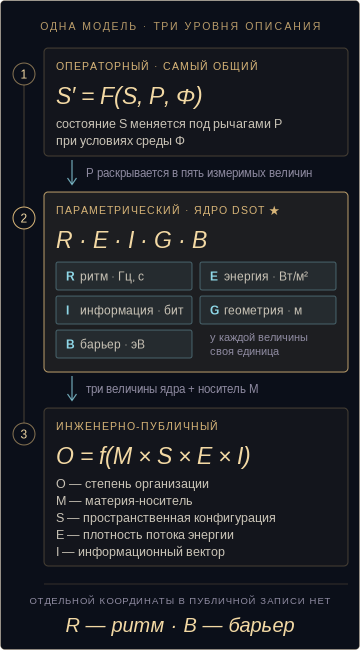
What sources the map is assembled fromcollapse
A systematisation based on the materials of V. Kovalev — the book “The Geometry of Phase Transitions”, the DSOT dissertation and the author’s primary sources.
Why there are several levels of description but one notation is publishedcollapse
The levels of description complement one another, and this is one model seen from three distances: the general framework, the core of five measurable quantities, the public notation. The fork “8 or 10 classes” also yields two complementary views.
One notation is published — O = f(M × S × E × I); the expanded formalism gives a core of five control parameters with units.
Expand section · the core formula, the levers, the classes of technologiescollapse section
The whole map · the core formula, five parameters, ten classes of technologiescollapse
why two storeyscollapse
The framework has two storeys: the foundation answers “how self-organisation happens at all”, the directed layer of DSOT — “how it can be directed”. The second storey is precisely the letter T in DSOT — Technologies.
Explanation of the notation and statuscollapse
ξ — order parameter · γ — damping coefficient · f(ξ) — nonlinear self-consistent function of internal interactions · F(t) — external fluctuation / resonant impulse of the environment. Near the critical point γ→0 (“critical slowing down”) — the system loses stability and restructures itself.
🟢 Support in established synergetics (Haken, Prigogine, the order parameter, resonance). The author’s step: the true order parameter ξ is the spatial-frequency geometry of the force framework; the transition proceeds along a discrete “octave staircase” of geometries. This is the book / quest circuit; it is not carried over into the academic one as a proven fact.
The directed layer of DSOT — one model at three levels of description (dissertation, Ch. 8–9). There is no contradiction between the notations:
explanationcollapse
The evolution of the state S under the control parameters P with the environmental conditions Φ. A phenomenological frame: it sets the form of the notation; its working-out on a concrete system is in the chapter on protocols.
P made concrete as five measurable quantities: R rhythm (Hz) · E energy flux density (W·m⁻²) · I information (bit) · G geometry (m) · B barrier (eV). The core is defined by a set of quantities, and for each one its unit and measurement procedure are named.
explanationcollapse
The public notation takes three quantities from the core — geometry (here it is S), energy flux density E and information I — and adds to them the carrier matter M; it has no separate coordinate for rhythm R or barrier B: O degree of organisation as a function of the aligned combination — M carrier matter (the mineral is a special case) · S spatial configuration (= geometry G) · E energy flux density · I information vector.
The same notation in words: matter creates form, energy creates motion, information creates structure, and self-organisation brings them together into a living whole.
Why a product and not a sum — and why the notation has no rhythm and no barriercollapse
A product (×), not a sum — because the parameters act in alignment: setting one factor to zero collapses the effect entirely (a working model, being tested). The public notation has no R and B — it is silent on when the action is applied and why the result holds. These two coordinates stand alongside, in the five-parameter core (branch C below).
The dissertation’s eight concepts yield five control parameters. Only what has a named carrier, unit, measurement procedure and range of applicability is admitted to the set.
all eight — as a listcollapse
The dissertation (Ch. 9) describes eight concepts — energy, geometry, structure, information, feedback, rhythm and resonance, spatial organisation, scale. Four of them became control parameters: energy, geometry (spatial organisation was also absorbed into it), information, rhythm. “Structure”, “feedback” and “scale” remained concepts of description — they have no unit and no measurement procedure, so they take no part in the relations and are not varied in experiment; they have not been thrown out of the work. Added as the fifth parameter is the barrier: it answers the question of why the state obtained does not fall apart at once. Each parameter stands on an established support.
The operational definitions of all five — carrier, unit, measurement procedure and limits of applicability — are deposited as a preprint with a permanent DOI: Five Control Parameters: Operationalising the set R · E · I · G · B.
Status: where the support is, where the author’s result iscollapse
🟢 The established supports are real (energy as a gradient, phase locking). 🟡 The reduction of eight concepts to five measurable parameters is the author’s result. “Information as a control parameter” and the aligned combination are a working hypothesis, being tested.
The author has declared the classification open: the number is not frozen.
by what feature the classes are distinguishedcollapse
The classes are distinguished by the physical nature of the control action — through which lever and through which medium the direction is carried out.
Ten classes: hydrodynamic · mineral · geometric · light · acoustic · electromagnetic · informational · biological · thermodynamic · terminalcollapse the classes
How “8” differs from “10”collapse
The “8” view — a core with a source (classes 1–6 are described word for word from the author’s primary source, 7–8 rest on the foundation). The “10” view — the author’s full open architecture: two closing classes, thermodynamic and terminal, are added to the eight. Both are true on their own horizon: “8” is the load-bearing skeleton, “10” is the declared completeness.
The taxonomy describes classes of technologies. The Mineral is not a separate branch of the map but the first prototype within class 2 (mineral technologies) and the first technology of the DSOT-MIN line. Below: its designation in the scientific apparatus, the seven generic lines of development and what the work puts forward for defence.
The working designation of “Kovalev Mineral” in the scientific apparatus is the mineral matrix of directed self-organisation. In the dissertation a separate chapter is devoted to it as the first experimental prototype of DSOT. The letter D in the name stands for directed: the same word stands in the name of the line to which the prototype belongs — DSOT-MIN, Mineral Directed Self-Organization Technology.
The chain the model describes: mineral — water — structure of the medium — processes in the cell — the system of the organism. Each link of this chain is a separate task of the verification programme.
The properties of the prototype are formulated as working hypotheses with a verification programme. Some of the characterisation methods remain a programme at the time of publication, and the measurements by them are still ahead.
Seven generic lines of development: DSOT-W · DSOT-MIN · DSOT-L · DSOT-S · DSOT-G · DSOT-EM · DSOT-Ccollapse the lines
The lines are set out by the author in the architecture of the DSOT dissertation, in the chapter on the classification of technologies: there are seven of them, from water technologies to technologies of consciousness. Of the seven, the mineral line entered the work first: the mineral is the platform’s first technology. These are directions of technology development according to the carrier medium.
The lines and the ten classes — two projections of one map: a line names the carrier medium, a class names the nature of the control action. The Mineral stands in both projections: as the DSOT-MIN line and as class 2, and in the scientific apparatus as the prototype MDSOM.
Six propositions put forward for defencecollapse the propositions
Word for word from the introductory chapter of the dissertation. Listed here is what the work undertakes to prove, and this differs from what has already been proven.
The subject of the work is strictly delimited: physico-chemical and biophysical aspects within a research frame — the propositions for defence do not go beyond this boundary.
Sources of the sectioncollapse sources
Sources: the book “The Geometry of Phase Transitions” (§0.2 the triad, §1.1 the order-parameter equation, §1.3 geometry as an order parameter) · the DSOT dissertation, Ch. 8–9 (formula and parameters), Ch. 11 (architecture of the classes) · the author’s primary source on classes 1–6 (group materials) · the seven lines DSOT-W…DSOT-C and the prototype name MDSOM — the architecture of the author’s dissertation · all versions of the formula are working and complementary; “8” and “10” are two views of one architecture. Classes 7–10 — by the author’s names from the architecture of the classes (Ch. 11), definitions — by the DSOT taxonomy.
04b — The Alchemist’s Library · what the science stands on
“Crystals” and DSOT have predecessors. Gathered here is a curated shelf of external authors and works on which the project relies or with which it resonates.
How the names were chosen for the shelf — and why no one has been “added by association”collapse
Selection is only of those whom Vadim Kovalev actually names or quotes in his materials (checked with grep across the corpus). No one has been “added by association”.
Which theories the project relies on — and which it does notcollapse
Which theories the project relies on — and which it does not. The answer is read by tiers, and the mere mention of a name decides nothing here. The load-bearing foundation of the scientific layer is tier A: self-organisation and non-equilibrium thermodynamics (Prigogine, Haken, Eigen, Kauffman), nonlinear dynamics (Mandelbrot), water and coherence (near-surface ordered water, Fröhlich), the criterion of scientific status (Popper). Tiers B and C serve as sources; they are not a foundation. These are names the author actually cites: from each we take an image, a question or a problem statement, and each line states what exactly and where our use ends. The lines of work on rotation fields, the wave genome and the “mirrors of time” are deliberately placed among the sources of images, and they are not part of the foundation of the scientific layer.
How to read the traffic light on this shelfcollapse
How to read the traffic light on this shelf: 🟢 established — part of the scientific foundation to which Vadim’s books refer directly · 🟡 we take an image, a question or a problem statement — what exactly is stated at each line · source of an image — the line is named as a source of inspiration; we look for support for the image in what is measurable. “The author is actually named by Vadim” and “the claim is proven by science” are two different axes: we checked the first here; the second remains under the general knowledge traffic light above.
Expand the shelf · five tiers of sources and how to read the traffic lightcollapse section
Eight fields · where to look for the real regularities of formcollapse
Where this list came fromcollapse
The list of eight fields is not the author’s formulation: it came into the project as an answer to his question — what in real science stands behind geometric symbols such as the “Flower of Life”. The question is the author’s; the list was brought in. The original answer was honest in another respect too — it says plainly that there is no recognised scientific monograph proving the “Flower of Life” to be a universal model of nature, and that one should look into these eight fields instead of the symbol. confirmed refers to the fields themselves: these are real branches of science. hypothesis — that it is precisely they that come together into the single framework of the project’s “science of form”.
Two of the eight fields — phyllotaxis and morphogenesis — stand here differently. For phyllotaxis the project has this list and a reference book, and the field is declared a direction of work. For morphogenesis the material is denser: the Turing mechanism and the Belousov–Zhabotinsky reaction are analysed in the working chapters of the project’s dissertation. research
Tier A · classics: Prigogine, Haken, Mandelbrot, ancient geometrycollapse
Where this shelf came fromcollapse
The main source is the annotated bibliography compiled by Vadim himself in the book “The Code of the Universe” (“Literature” sections I–III, 40 entries), plus the scientists named in the body of “The Geometry of Phase Transitions” and “The Biophysics of Awakening”. These are real scientists and real works belonging to established science.
10 entries: Prigogine · Haken · Eigen · Kauffman · Moiseev · Bertalanffy · Wiener · Ashby · Morincollapse the shelf
3 entries: Mandelbrot · Gleick · Strogatzcollapse the shelf
The adjacent circuit of the shelf — 23 entries A3 systems thinking · A4 consciousness and neuroscience · A5 technology and AI expandcollapse
7 entries: the exclusion zone · Fröhlich · Popper · Jung · Baevsky · the Schumann resonance · Vernadskycollapse the shelf
4 entries: Plato · Pythagoras · Fibonacci · Keplercollapse the shelf
Tier B · the frame and names outside the scientific corpuscollapse
B · Sources of the frameScientists from whom we take an image or a question what we take — at each lineexpandcollapse
The works of these scientists are an address in the literature. From each we take one thing — an image, a question or a problem statement — and each line states what exactly and where our use ends. The frame into which we place it is ours.
B2 · Names from the working materials, outside the scientific corpus
Four names that are named and quoted in the working materials — the research plan, dialogues and scripts — but that are absent from his scientific works (“The Code of the Universe”, the DSOT dissertation, “The Geometry of Phase Transitions”). From each work we take one thing — a question, an observation or neuroscience as it is — and each line states what exactly.
Tier C · sources of images — what we take from themcollapse
C · Sources of imagesNamed as a source of inspiration · we take the image and look for support in what is measurable not recognised by scienceexpandcollapse
These stories live in the author’s working materials, channel and biography; they are absent from his scientific works (“The Code of the Universe”, the DSOT dissertation, “The Geometry of Phase Transitions”). We have one measure, and it is our own: the support is a reproducible experiment. That is why from each line we take an image or a question, and we look for support for it in what is measurable — each line names where exactly.
By what rule a name goes on the shelfcollapse
The shelf grows by one rule: a name goes on it that the author himself names, and every name has an address — a source and a place in it. The system of 64 facets is DSOT’s own architecture, with its own language and practices, and its lineage is traced through the author’s works.
The lineage of the source lines · who did this, when and with which workscollapse
The tiers above answer the question “what do we take from the line”. Here is the answer to another question: where the line came from. Who led it, what exactly they proposed, how they tested it and what we take from it into our own work. The order is the reverse of the usual one: first the person, the years and the instruments — then the conclusions.
The cheap turn · a system’s state is changed not by the power of an influence but by its structurecollapse
Every electron and many nuclei have an intrinsic angular momentum — spin. Magnetic resonance imaging, electron paramagnetic resonance and a whole branch of chemistry rest on this phenomenon — a branch where the course of a reaction is decided by the mutual orientation of spins, and temperature recedes into the background.
This is where it gets interesting. Turning a magnetic moment with an external field takes work: the stronger the field, the more it costs. But the order in the spin subsystem can be changed incomparably more cheaply — and the characteristics of the crystal change noticeably as a result, because the spin subsystem is coupled to the lattice and to the exchange interactions within it. Only the direction and the order of magnitude are named here: what exactly changes in a particular sample, and by how much, is decided by the protocol of the verification programme.
Why this is here. The formulation that holds up the whole scientific layer: a system’s state is changed not by the power of an influence but by its structure. What is loud and energy-intensive destroys order; what is weak and precisely organised sets it. That is why directed self-organisation deals with the conditions of influence, and force is secondary here.
Where this story came fromcollapse
From a lecture of the line known as “rotation fields”; the address of the works is in the lineage of the source lines above. The lecturer says that the reorientation of spins proceeds with no expenditure of energy, while “almost all the characteristics” of the crystal change — the magnetic susceptibility, in his words, “almost by an order of magnitude”. This is what the lecturer says; there is no measurement of ours here. From this line we take the idea of the cheap turn: in physics it has its own name and its own instruments — the spin subsystem, spin-lattice relaxation, EPR.
A separate shelf · The Ether: the author’s mapcollapse
Gathered here is what the author builds his map of reality from: four levels — ① the zero point and the vacuum · ② rotation fields and information · ③ the conductor of light and life · ④ the materialisation of form. The shelf stands apart from tiers A, B and C, because it mixes things of different status: a verifiable fact of the history of chemistry, established physics and the author’s images. That is why the status here is given at each line separately.
The second edition of the manifesto was written by the author himself and is cleaner than the first: both the borrowed frames and the argument with anyone whatsoever have gone from it, and the mineral in it is neither named nor sold — the reader comes to it through geometry, not through a product. We regard it as the working one; the first edition remains the source of verbatim formulations.
A separate shelf · optics and photonics of ordered mediacollapse
The shelf has been set up for the quantum-optical circuit: these are the works and branches of physics on which the DSOT model relies directly. The difference from the “Ether” shelf is substantial — here almost everything is verifiable independently of us, is applied in industry and is taught. That is why the status of the lines is uniformly green, and this is a rare case on this page.
The shelf is needed here in order to name the branch of physics in which the mechanism is sought. Six of the seven lines can be checked in any university course — and this is exactly the verifiability for the sake of which the shelf was set up at all.
Sources of the sectioncollapse sources
Sources of the shelf: V. Kovalev’s own annotated bibliography in the book “The Code of the Universe” (“Literature” sections I–III, 40 entries) · quotations of real scientists in the body of “The Geometry of Phase Transitions” and “The Biophysics of Awakening” (the exclusion zone, Fröhlich, Penrose / Hameroff, Popp, Jung, Mandelbrot, Schumann) · Popper, Baevsky, Vernadsky from the library corpus · the quantum-metaphysical frame of DSOT — the author’s materials · sources of images — the author’s working materials, marked separately. The shelf has been checked against the author’s primary sources; only the authors he actually named have been selected. The traffic light follows the single standard of references; “present in the author’s materials” ≠ “proved by science”.
04c — The Mineral in the history of cultures · the third pillar
The mineral family of our Crystal has its own name and its own measure: aquahydrates, that is, substances in which water serves as the building material of the lattice itself. The class is defined by a feature that you can check yourself, and the author’s separate volume “Aquahydrates · Water as Structure” begins with this feature. Below is the history of how this group was recognised before formulas.
In full: what defines the class and why the volume speaks of it in numbers rather than in meritscollapse
Crystal hydrates are compounds into whose structure water enters in a stoichiometric ratio: the definition is broad, and it also covers dozens of salts in which water is a mere few per cent of the mass and leaves on gentle heating. The author’s own volume singles out within this set a narrower class — aquahydrates — and defines it by four features, each of which is verifiable: water makes up a share of the mass comparable to the rest of the substance · it occupies regular positions of the lattice, not cavities and not the surface · its removal destroys the structure rather than depleting it · the substance melts in its own water of crystallisation, without requiring a solvent.
The most visible feature is the fourth, and it is also the most underestimated. From the volume: “An ordinary solid needs external water in order to become a solution. An aquahydrate carries its solvent within itself and, on heating, passes into the liquid phase owing to what is already in its structure”.
How to read this sectioncollapse
How to read this section. A historical-cultural source answers the question “when and why did people do this”: it shows from which tradition the task grew and how lasting the interest in it is. The line is given because it is honestly verifiable, and it breaks off exactly where the sources break off. The present-day Mineral is described by the work’s own circuit — the physics of the crystal lattice, coherence and self-organisation. History on this page comes as an elegant reference, exactly as much as is needed for beauty; the main power is unfolded in the volume on aquahydrates and the whole group of minerals, where the same thing is explained through chemistry, physics and structure. This page holds the first half, the volume the second.
Expand the section · the epochs of one mineral familycollapse section
The epochs of one mineral family · and the author’s five red linescollapse
A substance older than chemistry itself
why age matters herecollapse
The first documented point of this line — and what matters in it is age. Substances of this group were found, named and put to use long before people learned to write formulas: they have accompanied civilisation for longer than the very word “chemistry” has existed.
For our subject, what matters is precisely predictability. The first quality that people noticed in this family was reproducibility — the very same quality that is required of a laboratory protocol today.
The philosophers’ salt — a name from the texts themselves
In the European alchemical tradition this substance stands alongside sulphur, mercury, salt and vitriol, and it stands among the central ones. Its role in the texts is to bind, purify and convert other substances.
sourcecollapse
Here we keep the precision that the author himself set: in alchemical texts this substance is called “the philosophers’ salt”, and it is by exactly this name that we call it. The line remains beautiful and, more importantly, remains true.
Islamic alchemy and medicine, not a sacred text
The substance held an important place in the Islamic alchemical and medical tradition — with Jabir ibn Hayyan and his successors. This school’s contribution to our subject is not in the substance itself: it was here that alchemy first acquired a laboratory character — operations, apparatus, reproducible techniques, classification. The Arabic school gave the European one not only substances but the very discipline of describing an experiment.
sourcecollapse
🔴 Red line: there is no direct mention of these salts in the Qur’an. The existing confusion arises from mixing up minerals, salts and sulphurous substances of late Islamic alchemy. We say “tradition” and do not say “Scripture” — the difference between them is precisely the difference between history and its appropriation.
The mechanism rests on the water inside the lattice
the mechanism and why the card is greencollapse
This line has an explanation, and it lies in the structure of the substance. Almost half the mass is water built into the lattice; by the volume density of water molecules this is almost water — and at the same time a solid with long-range order. Hence the feature that can be seen with instruments: at about 92 °C the substance passes into the liquid phase owing to its own water of crystallisation, without an external solvent.
This is where the boundary of the section runs: a historical line becomes valuable exactly when a physical explanation is found for it. Until that moment it remains a legend.
Twelve water molecules inside the lattice
The key fact for the sake of which this whole section stands on a scientific page at all: in the crystal hydrate of this family the water molecules are built into the crystal lattice itself — twelve per elementary formula unit. Water here is a structural element of the crystal, not an impurity and not moisture on the surface.
what follows from this and how it is knowncollapse
This gives a legitimate physico-chemical link “mineral ↔ water” — the very one that Part III of the monograph investigates. The high symmetry of the cubic crystal system also makes the family a convenient model system: lattice defects, crystal growth and the incorporation of impurities are well studied on it.
And the point for the sake of which the author refers to a separate volume. The class occupies an intermediate position between an ordinary crystal hydrate and a clathrate: the water subsystem is almost as developed as in a clathrate, yet it is held by the lattice itself, and no guest molecule is needed for this. It has no empty form — the departure of water rebuilds the framework into a different substance. Symmetry here works as a prohibition: a symmetry group is above all a list of prohibitions, and a whole class of phenomena is impossible in principle in such a lattice — it is not at all a matter of their “not having been detected yet”.
The volume “Aquahydrates · Water as Structure” →
The cultural layer: three thousand years behind one property →
Sources of the sectioncollapse sources
Source of the section: Vadim Kovalev’s own analysis, divided by him into the layers “what is actually known to science and history” / “a plausible research hypothesis” / “direction and presentation”; the page carries only the first layer and the red lines. The subject is called Mineral / Crystal; its chemical family is described in the language of crystal chemistry. The definition of the class, its four features and the numbers of the water subsystem are given from the author’s separate volume “Aquahydrates · Water as Structure” (ch. 1–3); the rule of the section is the author’s direct remark that history remains elegant reference information, while the main power is carried over into a separate volume on aquahydrates.
04c-bis — Four channels · what is measured, what is calculated and what is open
The “water — mineral” system is tested through four independent channels. The graduations on a measuring cup are marked before the water is poured in, otherwise the mark gets fitted to what was poured, and the order here is the same. The protocol is described, the thresholds are named before the measurement, and the result of the measurement for now remains an open question. Below are three columns: what is measured, what is calculated and what is open.
Absolute purity of the raw material — confirmed by laboratory control in an accredited laboratory. For the four channels of the “water — mineral” system there are no measurements yet; the thresholds for them have been named in advance.
A measure of the alignment of a multitude that is taken with a single sensor, and the threshold of its breakdown; the error budget of conductivity; the cost of the decisions taken in processing the spectrum. Everything listed is calculation, and it is labelled as calculation. A measure defined through phases is calculated only where phases are measured — which is why it is not carried over to a person.
The instrumental series for each of the four channels — the thresholds are named before the measurement, columns below. The work on the “water — mineral” system has no instrumental series on a person: at this scale it is the platform’s observational circuit that works — a diary of signs and voluntary self-report, in which a person sees their own record.
Expand the section · two circuits of instrumental workcollapse section
Four channels · measured, calculated, open — and how verification workscollapse
The protocol is described, the thresholds are named before the measurement; the result of the measurement is an open question.
Every point of this formula is open to checking. The protocol and the thresholds can be opened and read before the experiment, and for every published result a reproduction package is released — protocol, definitions of indicators, counting regulations, calculation code. The first such package — a computational one — is already open and is located at: release R0, with no password or registration; the register of all releases is here. A work that is called research is open to outside reading in full: the thresholds are recorded before the experiment, and the hash and timestamp make any substitution of data noticeable. Slices and releases with checksums are live on the reproducibility board.
Where the boundary of this layer runscollapse
The instrumental layer refers to the “water — mineral” system and describes its variability and reproducibility. It is not carried over to people’s behaviour in any form — these are different subjects and different channels of proof.
In a later edition of the work the biological layer is even carried into the title, but it is not part of the current edition. That is why, on the human scale, the boundary stands in the open: the work on the “water — mineral” system has no instrumental series on humans, and a different class of work operates there — the platform’s observational circuit, a signs diary and voluntary self-report, where a person sees his own record. biological response · open
Second circuit · six methods that define the object itselfcollapse
The four channels above answer the question “what has changed”. There is a stricter and earlier question: “and what exactly are we measuring” — that is, how the object is characterised as a material. Until it is closed, any spectrum refers to who knows what, and this remains true regardless of the quality of the text. The programme is named in full and in advance — together with the status of each line.
The table was published before the data were obtained: a programme declared in advance ties our hands, and we can be caught by it. Published after the fact, it would mean nothing. The second reason is named plainly: organising and paying for the analyses is a question of resources, and this item cannot be closed by editing the page.
Sources of the sectioncollapse sources
Source: the primary sources of the dissertation works — the list of four instrumental channels, the status of reproducibility as a separate task, the principle of convergence across independent channels, the composition of the methodological framework, the scope of the completed ethical part and the working formula for public texts in its current edition: the state of the instrumental part is reduced to a list of missing laboratory protocols — the thresholds are named before the measurement, the result of the measurement is an open question. The boundaries of the layer (what is in the work and what is not) are given in the work’s own formulations: the genre is declared as research, causal mechanisms are placed outside the scope, the limitations of sample size are named in the work itself. Not a single number from the work’s tables is brought onto the page: numbers are published only together with the measurement protocol.
The “measured”, “calculated” and “open” columns of the four channels: a computational-metrological work on the detection limit in conductometry, simulation works on spectrum preprocessing, on the parameter window and on a profile declared in advance, and a list of missing laboratory protocols with thresholds named before the measurement; the “measured” column for the section — laboratory control of the purity of the raw material.
04d — Blind Challenge · a programme of independent verification
The experiment will show how this crystal differs from an ordinary one. Its outcome is open, and it may turn out not to be in our favour.
The condition under which we ourselves will recognise the hypothesis as failedcollapse
That is why we describe it in advance, publicly and before the result is obtained: the programme, the success criterion and the condition under which we will recognise the hypothesis as failed.
Expand section · how the blind test and external verification workcollapse section
The reproduction package is open without a password or registration: release registry · latest chapter from the daily slice · reproducibility board.
How the blind test works · samples, steps and the condition under which our version failscollapse
This is how this order looks on what has already been calculated: in the “Open count” the denominator is declared before the counting, the negative outcome stands on the first screen, and both calculations can be recalculated by hand. Open the “Open count” →
two conditions of significancecollapse
The result is considered significant when two conditions are met simultaneously: the share of correct assignments is substantially above chance at a pre-set significance level and sample size — and external validation: reproduction of the procedure by a second independent laboratory on a new batch of samples. A single match without replication does not count as a result.
The same threshold in numbers. The significance level is declared in advance and equals α = 0.05 (two-sided), the batch is 10 samples: 5 ordinary and 5 processed. From here on the bar is not discussed but calculated:
- If the laboratory is told the composition of the batch (exactly five processed), what counts is only 10 correct assignments out of 10. The total number of ways to split “5 out of 10” is 252, and a chance hit is 1 in 252 ≈ 0.004. The nearest concession, “at least 8 out of 10”, gives 26 in 252 ≈ 0.103 — twice as high as the declared α, so it cannot be a threshold.
- If the composition of the batch is not named and each decision is independent, what counts is at least 9 correct out of 10: by chance this is 11 in 1024 ≈ 0.011. The “8 out of 10” bar gives 56 in 1024 ≈ 0.055 — beyond the α boundary, not accepted.
- Which of the two frames applies is written into the protocol before the key is unsealed, and after the result it is no longer chosen.
Below the threshold — we publish it as a negative result, together with the full protocol and this same calculation. The rule is one for both outcomes and is written here before the experiment.
What exactly is being tested — and why this is the language of materials sciencecollapse
The task is posed so that an instrument answers it: whether a crystal grown by our process can be reproducibly distinguished from an ordinary one. Why this happens is the next question, and it comes after the first. The substance is known, so uniqueness is sought in the history of crystallisation: the hypothesis is that the sequence of influences leaves reproducible traces in the defect structure. This is the language of materials science; there is no language of the “memory of water” here.
About numbers. Numbers on this page appear together with the measurement protocol and not before. This is the platform’s rule, and we can be caught by it. Estimates that circulated in drafts and brainstorms were not obtained in a laboratory, have nothing to do with our samples and are not brought onto the platform in any form. The status of this section is named plainly: programme declared, experiment ahead.
The blind test above answers the question “are the groups distinguishable”. It does not answer the second question, which any physicist will ask: isn’t the laboratory simply distinguishing the work of the equipment — heating, mechanical oscillation, the mere presence of the setup. That is why the second series runs in three groups, and the third of them exists precisely to remove this objection.
The difference “control ↔ full process” by itself does not separate the field from the setup. The claim passes in only one case: the sham group separates from the full process. If sham and full process are indistinguishable from each other, there is one conclusion and it is published — the observed difference comes from the equipment, and the field has nothing to do with it.
The threshold of the second series is declared in the same way as in the first: the significance level and the assignment rule are written into the protocol before the key is unsealed, and they are not chosen retroactively. The numbers of this series do not stand here because the series has not been carried out — the platform does not publish numbers before the measurement protocol.
How the difference is computed — the set of models and how they are testedcollapse
Separating the groups “by eye from the spectrum” is not proof. It is computed by a classifier, and the set is declared in advance: Random Forest, SVM and PLS-DA — three families of different nature, so that the result does not depend on one fortunate choice.
- External validation without fitting. The model is trained on one series and predicts another, one it has not seen. Accuracy within the training sample is not counted at all.
- Blind prediction. Assignments are issued before the key is unsealed and are recorded together with the model configuration.
- The configuration is closed before the run. The feature set, the parameters and the assignment rule are written down in advance: selecting the model by the result would turn the test into drawing.
Each of the three rules takes away from us the possibility of winning the argument unfairly — and precisely for that reason makes a won argument worth something. A test that cannot be failed confirms nothing.
Sources of the sectioncollapse sources
Source: the programme of the public experiment for the second dissertation work — five ordinary and five processed samples, an independent laboratory, the honest condition “if guessability is statistically significant”. The methods of defect analysis and blind classification are marked in the primary source as programme; there are no data on them. The requirements of double independence, prior declaration of the threshold and publication of a negative result are stricter than the original programme.
04d-bis — What we measure it with · the DDKS instrument, two circuits
The section above answers the question of how your crystal differs from an ordinary one, and it tests the substance. This section is the second half of the same pair: it is about how one measures the system, into which the substance enters.
How the instrument itself is built — DDKS, the indices and two slicescollapse
The instrument is called DDKS — a diagnostic questionnaire of the dynamics of coherence and synchronicity, with a block of ISSR indices and two slices: “Before” and “After”.
Expand section · two collection circuits, the base and the corpus of testimoniescollapse section
For science and the dissertation works the platform collects an array of empirical data: everyone who goes through its products becomes a participant in a large-scale empirical study.
One collection — two circuits · and what is measured by a number, not by a sensationcollapse
It is precisely the division into two circuits that makes the instrument scientific. For the person it is warm and clear, for science it is cold and verifiable, and neither of the two requirements has to be sacrificed.
On entry the participant fills in one card and does not edit it again. He names, before the start, what exactly should change and by which external event he will recognise it.
A sign written before the result cannot be fitted. This is the only part of the design that cannot be explained either by the participant’s expectation, or by his politeness towards the one who gave, or by regression to the mean. At the output exactly one number is counted — the share of designated signs that came true.
What is measured by a number, without relying on sensation. The term “idea → first artefact” in days · the discrepancy between plan and fact · the number of approval rounds · the number of tasks started and left unfinished · the share of designated signs that came true. In this way “time compression” is translated into a demonstrable quantity: a specific term before and a specific term after. No index is captioned with the word “proven”; the caption under the graph is one — “group-level observation, signs assigned before the start”.
The index names are kept as the author gave them; his words also name IFR and ISF. The published set is limited to those that have a behavioural support, and this was decided for the sake of the report’s honesty.
A test that cannot end badly for your version is not a test but a ceremony.
The criterion was formulated by the project itself — and applied here to its own instrument earlier than anyone outside had the chance to apply it. The first edition of the questionnaire did not pass this criterion: all the scales were directed one way, and the outcome “nothing has changed” simply did not exist in it.
Empirical base · how the array of observations becomes sciencecollapse
Empirical verification and analysis of data from a sample of more than 500 participants
The project’s archive of testimonies — video interviews, correspondence, questionnaires, public reviews accumulated since 2020. Vadim Kovalev: retrieve the whole base, transcribe the video materials, gather the primary data into a separate structured research section.
An array of this kind belongs to empirical data of the qualitative and mixed type. Processing proceeds by thematic coding: content analysis identifies recurring clusters of meaning — the speed of decision-making, the removal of inner doubts, coincidences of events.
Video interviews, text messages, public reviews and questionnaires are brought together. The agreement between what a person says on video, writes in correspondence and marks in a questionnaire reduces the probability of random error and of the bias of a single channel.
The material was collected in the participants’ projects, work and everyday life: in a laboratory the very fact of observation would change their behaviour. In the author’s own words: “when hundreds of people independently of one another describe similar patterns… in science this stops being ‘a random coincidence’ and becomes a stable statistical regularity or a phenomenological invariant”.
The qualitative corpus gives description, language and hypotheses: it shows what exactly people notice and in what words. It does not give causality: retrospection and self-selection remain in it by construction. That is why the array stands next to the prospective circuit B and does not replace it. Coding the array is a separate step of the programme: the numbers for this sample come out together with its protocol.
qualitative corpus- Attribution has been removed from the questions entirely. The link “instrument → effect” is not posed as a question: it may emerge from the comparison of groups — or it may not. A question that already contains the answer measures the person’s loyalty to the frame, and his state remains unmeasured.
- Zero questions about the body. The instrument asks about decisions, clarity and events — about what a person observes in his own activity.
- Consent to the research — on a separate screen, separately from consent to data processing; export is anonymised only.
- An honest timeframe. The first meaningful “before/after” slices — no earlier than three months after recruitment is launched; a sample suitable for the verification section means hundreds of participants with two complete slices, and tens are too few for it. No one has shorter timeframes.
Corpus of testimonies · where the qualitative material comes fromcollapse
The prospective circuit (the “Before” and “After” slices) gives data going forward. Next to it there is a second, retrospective array — what people wrote and said themselves, without a questionnaire and without our question. It is weaker in evidential force and stronger in language: it yields formulations that a researcher would not invent at a desk.
Mixed Methods with elements of longitudinal analysis
Below are the four instruments for processing the array under their own names, without retelling, and the four clusters of thematic coding: three of them are already named in the “Empirical base” block above, the fourth is added here.
① the speed of decision-making · ② the removal of inner doubts · ③ synchronistic events · ④ a physical sensation of harmonisation. A cluster is set before viewing the array — otherwise the categories are fitted to what one wants to see, and coding stops being coding.
The editorial rule for working with the corpus: contradictions within a single testimony and everything that leads the story into a conversation about illnesses are removed from the published edition — but the main essence of the message is kept, and it is precisely the contradiction that is removed, not the meaning. Two consequences, which we publish together with the rule because they are what make it scientific: the verbatim text of a testimony is kept in the archive, while the cleaned-up edition goes to the showcase — and the cleaned-up text is never passed off as a verbatim quotation. Either quotation marks and word for word, or our text without quotation marks.
The array was collected in personal channels and mostly before there was consent to take part in the research. Therefore: material enters the scientific corpus anonymised or after the author of the testimony has been asked again; on a public page — as personal experience, without a conclusion about the action of the product; a screenshot of someone else’s correspondence is never published. This restriction was written down before collection, and no first complaint was needed for it.
The retrospective array contains self-selection by construction: it is mostly those for whom it worked who write. That is why it gives language, themes and hypotheses — and does not give causality, however many entries it contains. The participant numbers are the author’s words with a reference to his materials, without our recalculation. Our own number for this array will come out together with the coding protocol — just like everything else on this page.
qualitative corpus · gives no causalitySources of the sectioncollapse sources
Sources: DDKS, the ISSR block, integration into all points of interaction, the “Before” and “After” slices, the names of the indices, the array for the verification section; the methodology of the sample of more than 500 participants (Mixed Methods, thematic coding, triangulation, ecological validity, “phenomenological invariant”) · the instrument specification: the division into two circuits, the designated-sign card, the list of measured quantities, the four conditions for the array to be defensible, an honest assessment of the timeframe. The criterion “a test that cannot end badly for your version is not a test but a ceremony” is the project’s own formulation, applied here to its own instrument. The texts of the questionnaire items are not brought onto the public page; the methodology is published.
04d-quater — The live picture of the environment · four layers without a survey
The environment can be seen in people’s actions; questionnaires are not needed for this. A day mark, a completed book chapter, an answer in an episode of the video course, a learning step, a digital-twin self-test and an assembled triad go into the event layer with precision to the second — for those participants who have permitted the scientific use of their data. From these events the platform itself computes four layers: rhythm, invested time, connectedness and the geometry of contacts.
the current state of the environment; it is not a source for the calculations of scientific works
Burstiness of the intervals between actions: closer to −1 — an even pace, around 0 — a random stream, closer to 1 — bursts.
Hours of active sessions over the window: a session is closed by 30 minutes without actions, and an open tab adds no hours.
Only pairs from joint activities, and only what lies above chance coincidence and the common calendar: an identical daily routine does not count as a connection.
The size of the largest connected group and its share, the average distance between people, bridges and reachability within two and three steps — as numbers, without a single node in a picture.
How each layer is computed and where the visibility threshold liescollapse
- The group visibility threshold. A layer opens when the quantity has been computed for no fewer than 10 participants (for connectedness — for 10 pairs). A distribution cell of fewer than three people is printed as “<3”. No one, including the owner of the platform, has an individual person’s trajectories in the picture.
- Rhythm. A 30-day window, no fewer than 10 intervals per person; if half of the actions fell on a single day, this is an episode, there is no rhythm here, and the quantity is not computed.
- Invested time. The duration of a session is the sum of the gaps between actions within it; a session of one action gives zero hours; the upper cut-off is the 99th percentile.
- Connectedness. Mutual information of the activity series, with a correction for short series, in excess of the median of a thousand shifted copies; below the 95th percentile — zero. A control is always computed alongside: random pairs with no joint activities. If there is no difference, what has been measured is the calendar, and the picture says exactly that.
- Geometry. An edge is actual joint actions; two threshold scales (one and three joint actions per window) are both published. Distance is computed over the largest connected group, if it has no fewer than 30 people.
- Consent. Only participants with a valid consent to the scientific use of their data enter the picture; withdrawing consent removes a person from the picture immediately.
Two layers of references. A — the immutable slice with a date, composition and checksum: the text of a scientific work refers to it and only to it. B — the live picture: today’s state of the environment, which changes along with it.
Slices and releases of layer A — with date, composition and checksum — are live on the reproducibility board, in the section “How this science is done”.
04d-quinquies — The anomaly detector · a finding with a denominator
A strong association picked out of a thousand tested ones is not yet a finding. The automaton searches the exploratory stream for unexpected jumps and proposes them to the queue of questions, but no finding leaves here on its own: next to it stand the magnitude with an interval, the number of comparisons tested and the computed expectation — how many such findings pure noise would give. The error threshold is declared before the run, written into the configuration with a date and a fingerprint, and is not moved retroactively. A question enters the queue only when it has an outcome we do not want.
candidates for questions; an exploratory finding is not a confirmation
All comparisons in the run are counted, including unsuccessful ones: windows × outcomes × main quantities, pairs and triples. Without this number a finding is not published.
The false discovery rate threshold is declared before the run and written into the configuration with a date; the correction method is named in the passport.
The outcome is shuffled among participants within the window, while the structure of the predictors is preserved; the mean over the surrogate runs and the upper bound are printed.
A permutation test, robustness to a change of window and to discarding part of the observations, a named undesired outcome — either all three gates are passed, or the finding stays in the registry without a place in the queue.
How the detector differs from a false-discovery machinecollapse
- A registry of all comparisons, including unsuccessful ones. With a thousand tests, several “strong associations” are guaranteed to appear from pure noise — which is why the number of tests over the period is published, and there is no selection of the successful ones alone here.
- The threshold is declared in advance. The false discovery rate within the family of comparisons of one run, the threshold and the correction method are written into the configuration with the date of declaration and a fingerprint; the run refers to the fingerprint.
- Permutation and robustness. The strength of a finding is compared with the distribution on shuffled data; a finding that disappears when the window is changed or part of the observations is discarded does not go into the queue.
- Nothing is lost. A finding that was not confirmed is never deleted: the date, the magnitude, the denominator and how it ended remain in the registry. A single jump is almost always noise; a jump repeated on another sample and at another time is almost always a phenomenon.
- Exploratory stream only. The detector works on the exploratory stream and does not touch the confirmatory stream: a test declared in advance must not come into contact with free searching.
The detector’s passport is open without a key: configuration, latest run and findings with three numbers. The run and the self-check are launched by the scientific team — the result is visible right here.
04e — The comma · a gap that is not an error
The page ends where the author’s corpus begins — on a single string. The string gives the shortest way to check everything said above: from here on arithmetic does the work, and everyone obtains its result for themselves.
Twelve pure fifths do not add up to seven octaves — see the gapcollapse the scene
The spiral is computed on the spot: the position of each point is log₂(3/2) taken the required number of times. The only golden line on the stage is the gap itself; it is the subject of the conversation.
The monochord, the comma and the number 531441 : 524288collapse
The monochord: why this is measurablecollapse
The monochord of Pythagoras is one string and a movable bridge. The first four numbers give all the basic consonances, and in sum they make ten. What the ear hears as beauty, matter writes down in whole numbers: beauty here is measurable.
No musical tuning in history has been able to remove this gap — it can only be distributed. All known temperaments are different ways to decide where to hide it, because it cannot be eliminated.
Expand section · the monochord, the comma and what the page closes withcollapse section
“This microscopic gap is not an ‘error’ of nature but its breath. It is precisely thanks to this gap that the musical system acquires inner tension, an impulse towards continuous movement and development.” V. Kovalev · “The Harmonics of Creation”, Part I, chapter 1
Analysis: Law 3, Law 4, Axiom 8 — and whose layer is whosecollapse analysis
Put together three propositions that already stand above on this page, and they turn out to be one thought. Law 3: qualitative changes do not arise instantly; a system accumulates internal changes for a long time. Law 4: until the threshold is passed, influences are compensated, and after the threshold even a small influence restructures the whole organisation. Axiom 8: any proposition remains open to refinement. All three describe one and the same construction — an unclosed gap, which is what keeps the system in motion.
A closed system in which everything has added up perfectly cannot develop: it has nowhere to go. That is why the science of self-organisation does not promise final answers: a final answer would be a standstill. For the same reason the “Blind Challenge” section was declared before the result, and the place where we may disagree has been named in advance and deliberately.
Which layer here is whose. The comma itself is arithmetic: 531441 : 524288 is checked without us and is not up for discussion confirmed. The reading of the gap as “breath” — Vadim Kovalev’s; the link between the comma and Laws 3 and 4 and the methodology of open questions — our reading of his text interpretation. These are two different layers, and we do not mix them.
Sources of the sectioncollapse sources
Source: V. Kovalev, “The Harmonics of Creation”, Part I, chapter 1 — §1.1 “The Monochord of Pythagoras and the Discovery of the Diatonic Intervals” (unison 1:1, octave 2:1, fifth 3:2, fourth 4:3; the Tetractys 1, 2, 3, 4 sums to 10) and “The Mathematics of the Pythagorean Tuning” (12 pure fifths do not coincide perfectly with 7 octaves; the gap is the Pythagorean comma, the ratio 531441 : 524288; the quotation about “breath” is given verbatim). We carried out the numerical check of 1.5¹² against 2⁷ ourselves: with it the reader can verify this independently. The link with Laws 3 and 4 and Axiom 8 is our interpretation.
05-bis — How this science is done · an open circuit instead of a closed folio
Everything above answered the question of what is being researched. This section answers the question of how it is done, and for the project it is one of the most important. We show how verification works: openly, in real time, together with what was not confirmed.
Here you can catch us in an error — and that is by designcollapse
It is breathtaking to be able to see how a result is obtained, and to catch us in an error.
The centre has a single order of steps by which this is done, and it is described separately — the DSOT method: observation → description → explanation → design → verification.
Expand section · synthesis, the log of steps, slices and mechanicscollapse section
AI in the methodology: what it does and what it does not docollapse
“We do not simply hide AI or quietly use it — we make it the official, breakthrough methodological core of our scientific novelty”. And in the same place, on the division of roles: “The human sets the frame, governs the meaning, chooses the vector, and the AI army instantly packages it into a rigorous academic and mathematical form”.
The author’s rationale: “Because of the routine of data processing, traditional science was limited to narrow samples. We overcome this limitation by using multi-agent circuits for the continuous verification of hypotheses on the live streams of the platform”.
Three places where co-evolutionary synthesis is declaredcollapse
The usual practice is to mention the tool in a single line in a footnote. Here it is declared in three load-bearing places of the work’s structure:
The log of AI steps · what is logged for each step with a modelcollapse
“We do not merely admit that we used AI — we hand over its protocol so that the analysis can be repeated and challenged step by step.” Disclosure of AI involvement is mandatory under current editorial standards, and most authors get by with a single line. Our move is to make this section the most substantive one, even if it turns out long.
Why we do not name the number of agentscollapse
Because the number measures nothing here. A hundred agents of one model are not a hundred independent opinions: they inherit the same biases, the same gaps and the same errors, and if the model systematically errs in a class of tasks, all hundred will err identically and confidently. The result is an illusion of consensus with zero gain in independence. Only heterogeneity adds weight — another model, another method, a person. That is why, instead of a number, we name the roles, the checks and what was rejected.
Frozen slices · why our numbers can be trustedcollapse
A live platform and a scientific text conflict at one point: the data change every day, while a claim in a work must be verifiable tomorrow and a year from now. The solution is architectural, and it was adopted before the first numbers appeared.
Above is the design. Here is its state at this minute, exactly as the server returns it. Each frozen slice has its own date, composition and checksum SHA-256: change even a single record in a slice, and the sum will stop matching. The hash and the timestamp make any substitution of data noticeable, so a number from a scientific work is checked against the slice without a password and without a single question to us.
Three subjects, three bridges. The method keeps the substance, the person and the environment separate and links them with three bridges. The second bridge: the share of plans carried through to completion is higher where the path between people in the network of joint activities is shorter — at equal baseline activity. The third: a jump in state is preceded by a rise in the variance and autocorrelation of the daily series. The refutation condition for both is recorded before the data: not higher — the second bridge does not hold; does not precede — the third does not hold. The first bridge, from the substance to the person, is tested by a separate protocol with the consent of participants.
Full checksums of the slices and the release verification commandcollapse
Two layers on this board too. A — slices and releases: immutable; the text of a scientific work refers to them and only to them. B — log counters and the time of the reading: today’s state of the circuit, which changes along with it. The live picture of the environment is also layer B, only about people’s actions: the section “The live picture of the environment”. The server’s responses in full: slices · releases · circuit state.
Ten mechanics, three cross-cutting rules and the registry of open questionscollapse
The meanings and mechanics of a self-organising science work in the platform’s interface as a product tool. The breakdown into ten mechanics, an acceptance measure for each and three cross-cutting rules are the engineering form of this assignment. Shown below is the showcase of the process: how the results were obtained.
The set is shown in full, all ten indicators, including those with nothing to boast of. Right after the list comes a second table: for each mechanic it names the acceptance measure, what has already been assembled for it and what is not there yet. A mechanic without data remains a description and a measure — not a picture with an approximate number.
A mechanic is easy to announce and impossible to verify until it is stated what exactly makes it count as done. Each mechanic has three columns: what verifies it · what is already in place · what is being assembled now.
What verifies each mechanic →collapse
Revision feed — 6 entriescollapse
Below are all the revisions of conclusions made since the log began. The previous wording is preserved in full: without it, a month later the revision cannot be assessed — “it was roughly like this” is not a quantity. An entry is never deleted; even a cancelled revision is recorded as the next entry, and the old one stays as it was. The feed is kept as a machine-readable registry of revisions and is open in full below.
The measure of the log’s soundness is the reverse of the usual one: zero entries over a period of work means not “we made no mistakes” but “we did not check or did not record”.
There is not yet a single number about the environment on this page, and that is a fact: there are no slices with records of individual participants yet — the registry holds a computed slice of the model and an aggregate slice of the platform’s indicators — and there is no active set of observations. The order adopted is the reverse of the usual one — first comes the architecture that will not let a number appear without a counting procedure, and only then do numbers appear. The reverse order would have given a beautiful screen on which every figure meant precisely nothing.
- Zero promises of an effect. None of the mechanics shows or implies a result that a person “should” get.
- Zero personal scores and ratings. A research participant is not compared with other participants and receives no grade.
- Taking part in the research gives neither access nor a discount. As soon as participation starts being paid for with anything, data stop being data.
- Three of the twelve are independent programmes: a second cohort from a different year of entry · replication by people unconnected with us · transfer between areas of life.
- This is a literal implementation of what the page declares above: we say it out loud where there is no answer, instead of painting over the void with a hypothesis. The label “open question” on this page stops being a label and becomes a section.
- The registry, for its part, converts the work from a report into a programme, which serves as “a base for dozens of new studies over a horizon of 10, 20 and more years”.
- A failure of a mechanic is also a scientific result. Recording a failure closes a whole class of approaches: the next person to take this road will learn about it before spending a year on it.
- An empty registry of failures is a sign of malfunction. The absence of entries over a period of work counts as one of the signs that the whole tier is unsound: a system that has no list of its own failures does not develop itself — it tells stories about itself.
- The outcome is declared before the data. A hypothesis enters the registry together with what will count as its refutation; the meaning of the outcome is added after publication and does not replace it. The instrument has no “do not publish the outcome” command, by design.
- Water memory is described through carriers: the long-term part of the trace is held by the ordered phase and the geometry of the bonds — the structure of water.
- The order parameter does not transfer to people directly. The quantity requires measuring phases, and a sequence of human actions has no period and no phase origin in the required sense — the value cannot be computed by any reproducible method. Instead, observable properties of a discussion are taken: the share of remarks left without an answer, the time to the first objection.
- A measure of wholeness through exhaustive search over partitions is computationally unattainable. It is defined theoretically; the cost of computation differs from the available resources by orders of magnitude. There is no replacement, and this is recorded honestly, as an empty line.
Sources of the sectioncollapse sources
Sources: AI as the declared methodological core, three places in the structure (the Introduction “Co-evolutionary Synthesis” · the methodology chapter “The Living Toolkit” / Living Research Engine · the conclusion as an open repository instead of “a folio shut away on the shelf”), the end-to-end control protocol and the algorithms for detecting critical transitions · the specification of the scientific data architecture: the event layer L1, the indicator registry L2, the frozen slices L4 and the rule “a new indicator means a new code” · the specification “science as an interface” and its supplement on live analytics for the participant: ten mechanics — all ten are put on the showcase, each with its own acceptance measure and state of readiness — and three cross-cutting rules · the section “AI participation” and the log of AI steps under the current editorial disclosure standards · the registry of open questions O-01…O-12 with the column “what refutes it”. The number of agents and the wording about a degree being conferred on the platform are not put on the showcase — the reasons are given in the comment to the section. The weighting rule (“a hundred agents of one model are not a hundred independent opinions”) and the requirement of a person’s signature under a revision of a conclusion have been added on top of what the author said: without them the mechanic turns into its opposite.
05 — The Centre’s scientific archive
Everything this page refers to lies here in one list: the monograph, two dissertation works, the dissertation abstract, the Constitution of Science, the package of articles and the bibliography. Open for reading — the Portal itself is the place of publication.
The corpus tutor can search inside these works line by line. It finds the nearest place in the primary source, names the work and the section, and retells nothing in its own words.
The articles of the package are posted one at a time — as a preprint with a date and a version, before submission to a publication. Next to the text of each, it is stated what it establishes, what it does not establish and how this is checked. The first is already up: a protocol that is discussed before data collection.
Deposited · the Centre’s works in an open repository
17 works of the Centre are held in an open scientific repository. Each has its own permanent DOI: a work can be opened, downloaded and cited in a reference list.
The full list — title, date, code, link →collapse
- Five Control Parameters: Operationalising the set R · E · I · G · B — carriers, units, measurement procedures and limits of applicability preprint · 20.08.2026 · code D-02 · DOI 10.5281/zenodo.22028888.
- Batch as quasi-random assignment: conditions under which manufacturing batch can serve as a natural experiment in observational studies of consumed products preprint · 20.08.2026 · code M-01 · DOI 10.5281/zenodo.22021639.
- Three energetic quantities that must not be conflated: amount, gradient and steadiness of flux, the withdrawal of a universal principle of regime selection, and a transferred form of non-monotonic dependence preprint · 24.08.2026 · code D-03 · DOI 10.5281/zenodo.22077697.
- Provenance of AI-assisted analysis: a disclosure and reproduction protocol for research involving language models preprint · 24.08.2026 · code M-02 · DOI 10.5281/zenodo.22077699.
- A union-bound tolerance rule and the information price of a fitted orientation in spatial-coincidence tests on the sphere preprint · 24.08.2026 · code P5-01 · DOI 10.5281/zenodo.22077512.
- Presence, Not Memory: A Kinetic Framework for Distinguishing Transient and Persistent States in Aqueous Systems preprint · 25.08.2026 · code J-01 · DOI 10.5281/zenodo.22095044.
- Estimating the Local Jacobian of an Aqueous System from Perturbation-Response Spectroscopy preprint · 25.08.2026 · code J-03 · DOI 10.5281/zenodo.22095035.
- A Dimensionless Retention Criterion for Induced Order in Water-Material Systems preprint · 25.08.2026 · code J-04 · DOI 10.5281/zenodo.22095037.
- Physicochemical Characterization of a Water-Mineral System under Controlled Electromagnetic Conditioning: A Pre-Registered Protocol (Registered Report, Stage 1) preprint · 02.09.2026 · code G-01 · DOI 10.5281/zenodo.22251008.
- Spectroscopic Indicators of Hydrogen-Bond Network Modulation in a Water-Mineral System under Controlled Electromagnetic Conditioning: A Pre-Registered Protocol (Registered Report, Stage 1) preprint · 02.09.2026 · code G-02 · DOI 10.5281/zenodo.22251203.
- Temporal Stability and Relaxation of Spectroscopic Signatures in a Water-Mineral System Prepared under Controlled Electromagnetic Conditioning: A Pre-Registered Protocol (Registered Report, Stage 1) preprint · 02.09.2026 · code G-03 · DOI 10.5281/zenodo.22251251.
- Evaluation of Methodological Negative Controls in Spectroscopic Studies of a Water-Mineral System: A Pre-Registered Protocol (Registered Report, Stage 1) preprint · 02.09.2026 · code G-04 · DOI 10.5281/zenodo.22251300.
- Replication and Robustness Across Independent Experimental Sessions in Water-Mineral Spectroscopic Studies: A Pre-Registered Protocol (Registered Report, Stage 1) preprint · 02.09.2026 · code G-05 · DOI 10.5281/zenodo.22251340.
- Parameter Sensitivity and Boundary Conditions of Spectroscopic Effects in Water-Mineral Systems: A Pre-Registered Protocol (Registered Report, Stage 1) preprint · 02.09.2026 · code G-06 · DOI 10.5281/zenodo.22251384.
- A Falsifiable Framework for Condition-Dependent Spectroscopic Effects in Water-Mineral Systems: Constraints Declared in Advance (Registered Report Programme, Stage 1) preprint · 02.09.2026 · code G-07 · DOI 10.5281/zenodo.22251419.
- Feasibility, Adherence and Coder Reliability of a Prospective Anticipation-Card Diary: A Registered Report Protocol preprint · 03.09.2026 · code S-06 · DOI 10.5281/zenodo.22263526.
- Do anticipated events occur more often? A prospective longitudinal protocol with a naturally occurring waiting group preprint · 03.09.2026 · code S-07 · DOI 10.5281/zenodo.22263453.
Expand the archive · the Centre’s works, the external circuit and how to citecollapse section
The archive shelf · 11 works of the Centre, from the monograph to the bibliographycollapse
The external circuit · where and in what order this is defended
The external circuit · where and in what order this is defendedcollapse
Four ready-made references and the self-citation rulecollapse the apparatus
The Centre’s works are open for reading on this Portal. Three of them have an English edition 1.0 deposited in Zenodo with a persistent DOI identifier: it is named in the reference by its own title and date. The Russian version on the Portal is cited by the Portal URL. The format below is the research centre’s self-citation.
Publication in our publishing circuit raises the status to that of a publication; the next step is an independent reproducible experiment, and each work goes towards it by its own protocol. The year (2026) and authorship are taken from the title pages of the works. We do not ascribe external journals, other people’s DOIs or ISBNs.
The materials of the Centre for Directed Self-Organization are of a research and educational nature. The concepts presented are hypotheses under research that do not establish a cause-and-effect mechanism.
Next — the works themselves
The Centre’s first work is already available as open text: the protocol, version 1.0 — the procedure was declared before data collection began. From here the path leads to the bridge from the string of Pythagoras to the Mineral, and to the technology by which the crystal grows.